
# Gold Price Nears Session High as US Jobless Claims Miss Forecasts
Gold prices firmed on Thursday after weaker-than-expected U.S. labour market data supported bullion demand. For Indian investors, the move matters because softer U.S. economic data can influence the U.S. dollar, Treasury yield expectations, and in turn the rupee gold rate.
Why did gold price move higher after U.S. jobless claims data?
Gold prices moved higher because fresh U.S. weekly jobless claims came in above market expectations, signalling some softening in the labour market and supporting safe-haven bullion.
The U.S. Labor Department said initial claims for state unemployment benefits reached a seasonally adjusted 214,000 for the week ending April 18. Economists had expected 212,000 claims.
The previous week’s figure was also revised higher to 208,000 from 207,000. That combination gave gold an immediate tailwind after the data release.
In precious metals markets, weaker labour data can raise expectations that the Federal Reserve may face pressure to turn less hawkish if economic momentum slows. That tends to support gold price, XAUUSD, and broader safe-haven demand.
What happened to spot gold after the data release?
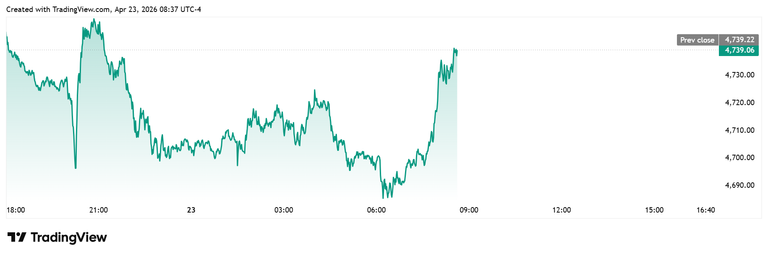
Spot gold climbed back toward its overnight peak after the U.S. claims report and stayed close to session highs in Thursday morning trade.
According to the source report, spot gold had spiked to $4,753.79 per ounce just after 9:00 pm. It later traded at $4,739.28 per ounce, which left it broadly flat on the daily chart while still holding close to the upper end of the session range.
That price action suggests traders were willing to keep exposure to bullion even without a major daily breakout. In market terms, gold held firm rather than giving back gains after the data surprise.
For Indian investors, strong international spot gold or troy ounce prices can feed into domestic bullion rates, although the final impact also depends on the USD/INR exchange rate, import duties, and local premiums.
What do the four-week average and continuing claims say about the U.S. labour market?
The broader labour market picture was mixed, but not strong enough to pressure gold lower.
The four-week moving average of new claims, which many economists view as a steadier gauge because it smooths weekly volatility, came in at 210,750. The previous week’s revised average was 210,000.
That reading was also below expectations for 219,000. So while the headline initial claims number was weaker than forecast, the moving average did not show a sharp deterioration.
Meanwhile, continuing jobless claims stood at 1.821 million for the week ending April 11. That was slightly above expectations of 1.820 million.
At the same time, continuing claims were above the previous week’s downwardly revised 1.809 million level. This indicates that more people remained on unemployment benefits, even if the increase was modest.
How do weaker U.S. labour data affect gold and Indian bullion buyers?
Weaker U.S. labour data usually support gold because they can lower real yield expectations and improve the appeal of non-yielding safe-haven assets.
Gold does not pay interest, so it often performs better when investors think U.S. interest rates may stop rising or eventually fall. Even a small miss in economic data, such as 214,000 claims versus the 212,000 forecast, can influence short-term trading in XAUUSD.
For Indian buyers, the impact goes beyond global bullion charts. If softer U.S. data weaken the dollar, that can cushion imported gold costs in rupee terms. But if the rupee also weakens, domestic prices may still stay elevated even when international gold pauses.
This is why Indian investors should watch both spot gold prices and USD/INR moves together, rather than looking only at the dollar price per troy ounce.
What should gold investors watch next after this jobless claims report?
Gold investors should now watch whether upcoming U.S. data confirm a broader cooling trend in the labour market.
This week’s report showed initial jobless claims at 214,000 for the week ending April 18, above the 212,000 consensus, while spot gold traded near $4,739.28 per ounce after touching $4,753.79. If future labour, inflation, or Federal Reserve signals reinforce the idea of slower U.S. growth, bullion could keep drawing safe-haven interest.
For Indian investors, the key watchpoint is whether global gold remains near highs while the rupee stays stable. That combination would keep domestic gold prices sensitive to every fresh U.S. macro release.