
# Gold Price Near Session High as US Jobless Claims Hit 200,000
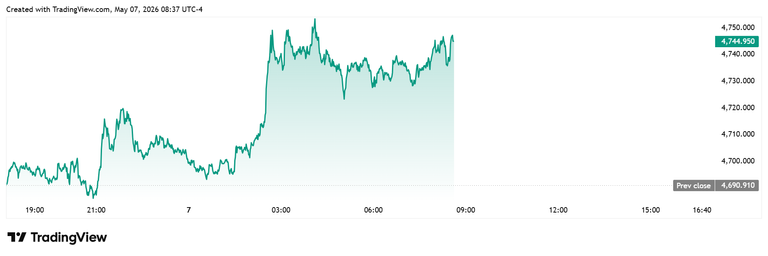
Gold prices held close to session highs on Thursday after the latest U.S. weekly jobless claims data came in stronger than economists expected. The data signalled continued resilience in the U.S. labor market, yet spot gold still traded at $4,745.00 per troy ounce, up 1.15% on the day, showing that bullion demand remained firm.
For Indian investors, the move matters because international gold price action in XAUUSD often feeds directly into domestic bullion rates after adjusting for the USD/INR exchange rate, import duties, and local premiums.
What happened to gold price after the U.S. jobless claims data?
Gold price stayed near its session high even after the U.S. labor market report beat forecasts. Just before the 8:30 a.m. release on Thursday, spot gold was already trading close to intraday highs and was last quoted at $4,745.00 per ounce, a 1.15% daily gain.
That reaction is notable because stronger-than-expected U.S. employment data can sometimes pressure precious metals by supporting the U.S. dollar and Treasury yields. In this case, however, gold held firm, suggesting that safe-haven interest and broader market positioning continued to support bullion.
Where did spot gold trade?
Spot gold traded near session highs and last changed hands at $4,745.00 per troy ounce. The move left XAUUSD up 1.15% on the daily chart.
What did the latest U.S. weekly jobless claims report show?
The report showed fewer Americans filed for unemployment benefits than economists expected. The U.S. Labor Department said initial claims for state unemployment benefits came in at a seasonally adjusted 200,000 for the week ending May 2.
Economists had expected 205,000 claims, so the actual reading beat consensus forecasts. The previous week’s figure was also revised higher to 190,000 from 189,000.
Why does initial jobless claims data matter for gold?
Initial jobless claims matter because they offer a timely snapshot of the U.S. labor market, which can influence expectations for the Federal Reserve, U.S. interest rates, the dollar, and in turn the gold price. A stronger labor market can reduce expectations for rate cuts, which is usually a headwind for non-yielding assets such as bullion.
What did the four-week moving average reveal about the labor market?
The four-week moving average also came in below expectations, reinforcing the picture of labor market strength. This average, which smooths weekly volatility and is often treated as a more reliable indicator, stood at 203,250.
That was below the market expectation of 209,000. Because this measure filters out one-off swings, traders often watch it closely when assessing whether U.S. employment conditions are truly weakening or staying resilient.
Why do markets track the four-week average?
Markets track the four-week average because it gives a cleaner read on underlying labor trends than a single weekly print. For gold traders, that matters because a steadier labor market can affect expectations for Federal Reserve policy and therefore the outlook for bullion and other precious metals.
How did continuing jobless claims compare with forecasts?
Continuing jobless claims also beat expectations. The number of Americans already receiving benefits came in at 1.766 million for the week ending April 25.
Economists had expected 1.800 million continuing claims. The previous week’s level was also downwardly revised to 1.766 million.
What do continuing claims tell investors?
Continuing claims show how easily unemployed workers are finding new jobs after entering the benefits system. A lower reading can indicate that the labor market remains relatively tight, which can shape expectations for U.S. monetary policy and influence safe-haven demand for gold.
Why are Indian investors watching U.S. labor data and XAUUSD?
Indian investors watch U.S. labor data because it can quickly move global gold price benchmarks and alter the outlook for domestic bullion prices. When U.S. data beats forecasts, traders often reassess the path of Federal Reserve interest rates, which can move the dollar and global XAUUSD pricing.
For India, the final impact depends not only on international spot prices but also on the rupee’s exchange rate against the U.S. dollar. If gold rises in dollars and the rupee weakens at the same time, domestic gold rates can climb faster. If the rupee strengthens, it can partially offset gains in global bullion prices.
Indian buyers, jewellers, and investors in gold ETFs should also watch how firm U.S. labor data affects expectations for interest rates, because that can influence short-term volatility in gold, bullion, and other safe-haven assets.
The next key watchpoint for the market is whether upcoming U.S. economic releases continue to confirm labor-market resilience. If they do, traders may reassess the path of Federal Reserve policy, while gold’s ability to hold near $4,745 per ounce will remain crucial for near-term sentiment in global and Indian bullion markets.