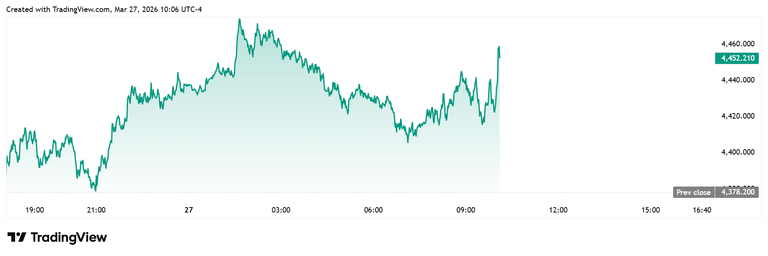
Gold prices rallied sharply on Friday after weak U.S. consumer sentiment data and rising inflation expectations boosted safe-haven demand for bullion. For Indian investors, the move matters because a stronger global gold price in XAUUSD can quickly feed into domestic rates, especially if the rupee stays weak against the U.S. dollar.
The source report also carries a notable pricing discrepancy: its headline said spot gold shot above $4,550 per troy ounce, while the body said spot gold was last trading at $4,453.16 per ounce, up 1.70% on the day after the 10 a.m. EST data release.
Why did gold price jump after the U.S. consumer sentiment report?
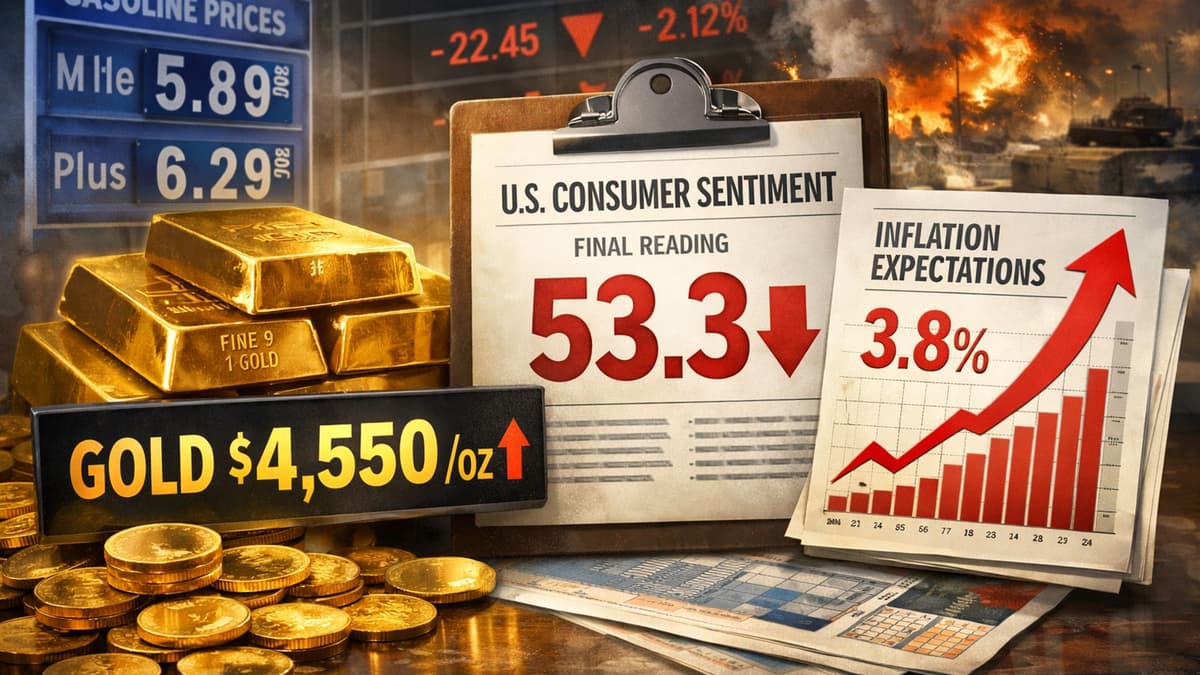
Gold price jumped because the latest U.S. data showed weaker consumer confidence and hotter near-term inflation expectations, a combination that often supports safe-haven demand for precious metals. Traders responded immediately after the University of Michigan released its final March Consumer Sentiment reading.The University of Michigan said the final Consumer Sentiment Index for March came in at 53.3 on Friday. That was worse than the 54.0 consensus forecast from economists, below the preliminary reading of 55.5, and lower than February’s final 56.6.
After the 10 a.m. EST release, spot gold surged, with the article stating that gold was last trading at $4,453.16 per troy ounce, up 1.70% on the day. In risk-off conditions, softer sentiment and rising inflation expectations can increase demand for gold, bullion, and other safe-haven assets.
For Indian investors, a rally in international gold price benchmarks such as XAUUSD can raise local bullion prices even faster when the rupee weakens. That means global macro data from the United States can directly affect Indian jewellery buyers, traders, and long-term gold allocators.
What did the University of Michigan consumer sentiment data show?
The report showed that U.S. consumer sentiment weakened further in March and fell to its lowest level since December 2025. The decline was broad-based across demographics and political groups, according to the survey authors.Surveys of Consumers Director Joanne Hsu said, "Consumer sentiment fell back 6% this month to its lowest level since December 2025." She added that declines appeared "across age and political party."
Hsu also said consumers with middle and higher incomes and stock wealth saw particularly large drops in sentiment. She linked that weakness to "escalating gas prices" and "volatile financial markets" following the Iran conflict.
That detail matters for gold because geopolitical stress and market volatility often push investors toward defensive assets. When households feel less confident and geopolitical risk intensifies, gold frequently benefits from its safe-haven status.
How did inflation expectations change, and why does that matter for gold?
Year-ahead inflation expectations rose sharply, and that supported gold because bullion often attracts buyers when investors worry that inflation will stay elevated. Rising inflation expectations can also shape views on Federal Reserve policy, real yields, and the U.S. dollar.The University of Michigan said year-ahead inflation expectations jumped from 3.4% in February to 3.8% in March. That was the largest one-month increase since April 2025.
Joanne Hsu said, "The current reading exceeds those seen in 2024 and remains well above the 2.3%-3.0% range seen in the two years pre-pandemic." That comparison suggests consumers see inflation risks as materially higher than the more stable levels recorded before the pandemic period.
The survey also showed that long-run inflation expectations edged down to 3.2%. Hsu noted that in 2024, long-run inflation values ranged between 2.8% and 3.2%, while in 2019 and 2020 they were consistently below 2.8%.
For gold traders, higher short-term inflation expectations can support prices because investors often use precious metals as a hedge when purchasing power looks vulnerable. Indian investors should watch this closely because imported inflation and currency moves can magnify the impact on domestic gold rates.
What did Joanne Hsu say about the economic outlook and the Iran conflict?
Joanne Hsu said the short-term U.S. economic outlook deteriorated sharply, while consumers became notably more pessimistic about their personal finances. She also warned that the Iran conflict and higher energy prices could worsen the inflation backdrop.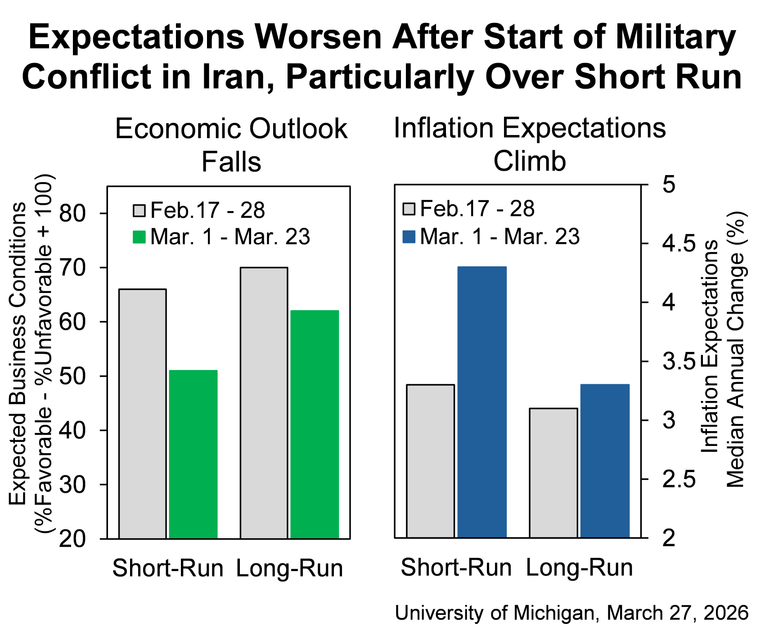
Hsu wrote, "Overall, the short-run economic outlook plunged 14%, and year-ahead expected personal finances sank 10%, while declines in long-run expectations were more subdued." That suggests consumers saw immediate pressure building even if they did not yet fully assume the damage would last for years.
She added that consumers "may not expect recent negative developments to persist far into the future." However, she warned that views could change "if the Iran conflict becomes protracted or if higher energy prices pass through to overall inflation."
That point is especially important for gold. A prolonged geopolitical conflict, rising oil prices, and broadening inflation pressure can all reinforce safe-haven buying in bullion markets.
When was the survey conducted, and what does the timing tell investors?
The survey timing suggests the Iran conflict had a meaningful effect on sentiment and inflation expectations. Much of the fieldwork happened after the conflict began, which gives investors useful context for the weakness in the data.Hsu said interviews for the release were collected between February 17 and March 23. She added that about two-thirds of the interviews were completed after the start of the U.S. military conflict in Iran.
She also noted that for both inflation time horizons, interviews completed after February 28 showed higher inflation expectations than those completed before that date. That implies geopolitical developments and related energy-price concerns likely played a major role in shifting household expectations.
For Indian market participants, this matters because oil, inflation, the U.S. dollar, and gold are closely linked. If Middle East tensions keep energy prices high, Indian inflation expectations and rupee sensitivity could become more important for domestic bullion pricing.
What should Indian gold investors watch next?
Indian gold investors should watch U.S. inflation expectations, Federal Reserve signals, the Iran conflict, oil prices, and the rupee-dollar exchange rate. These factors can determine whether the latest jump in gold price extends further or faces profit-taking.The key near-term signal is whether rising inflation expectations at 3.8% start influencing broader rate expectations and safe-haven flows. If geopolitical tensions intensify and energy prices keep rising, global gold prices could stay supported; if tensions ease, volatility in XAUUSD may increase.
For now, the combination of weaker U.S. consumer sentiment at 53.3, a 6% monthly drop in confidence, and the sharp rise in one-year inflation expectations has strengthened the bullish case for gold. Indian investors should monitor not just the international troy ounce price, but also INR movement, since domestic bullion prices reflect both global gold and currency trends.