# Gold Price Holds Sharp Gains After US GDP Miss, Core PCE at 3.2%
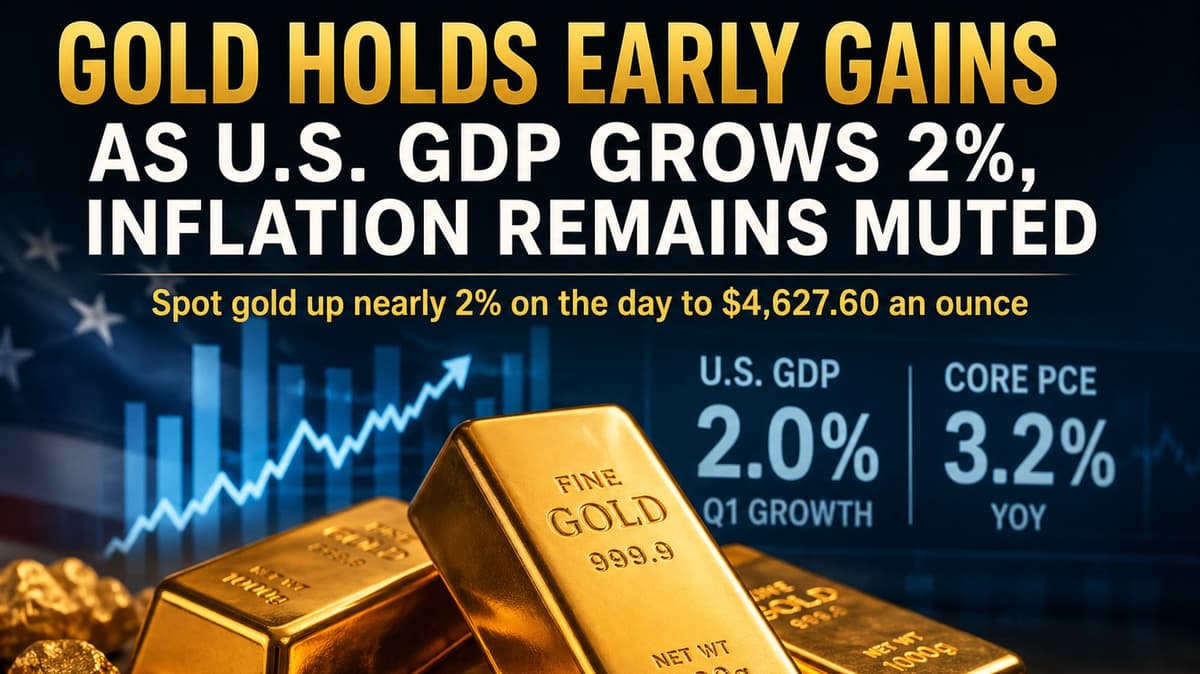
Gold prices held firm after the latest U.S. economic data showed slower-than-expected growth and still-elevated core inflation. Bullion did not break decisively in either direction, but spot gold was last quoted at $4,627.60 per troy ounce, up nearly 2% on the day, as traders assessed the implications for the Federal Reserve, the U.S. dollar, and safe-haven demand.
For Indian investors, the move matters because global XAUUSD prices, Federal Reserve rate expectations, and inflation trends often feed directly into domestic gold prices through the rupee-dollar exchange rate and import costs. Even when international bullion lacks immediate direction, elevated U.S. inflation and slower growth can still shape near-term sentiment in the Indian gold market.
What did the latest US GDP data show for gold prices?
The U.S. economy grew, but it grew more slowly than expected, which helped gold hold gains rather than trigger a major selloff. According to the U.S. Bureau of Economic Analysis (BEA), the first estimate of U.S. first-quarter Gross Domestic Product (GDP) showed the economy expanded 2% in the first three months of the new year.
That marked a clear improvement from the 0.5% growth reported in the fourth quarter. However, it still missed consensus estimates, as economists had expected 2.2% growth in Q1.
A softer-than-expected GDP reading can support bullion because it suggests economic momentum is cooling. At the same time, the fact that the economy is still expanding limited the immediate bullish reaction in gold.
What components drove Q1 GDP growth?
The BEA said several parts of the economy contributed to the rise in real GDP. Specifically, the report said investment, exports, consumer spending, and government spending all supported growth.
The report also noted that imports increased. Because imports are subtracted in the GDP calculation, that increase acted as a drag within the headline growth framework.
What did the PCE inflation data reveal?
The inflation data showed price pressures remain elevated, but not materially worse than expected. In a separate report, the BEA said the Personal Consumption Expenditures (PCE) Index rose 0.7% last month, following February’s 0.4% increase.
On an annual basis, headline inflation rose 3.5%. The report linked part of that price pressure to the global energy supply crisis caused by the war in Iran, which continues to push headline prices higher.
For gold, this matters because inflation tends to support demand for hard assets and safe-haven stores of value. But when inflation stays high without collapsing growth, traders also weigh the risk of higher-for-longer U.S. interest rates.
What happened to core PCE inflation?
Core inflation remained elevated but did not show a fresh surge. Core PCE, which strips out volatile food and energy prices, rose 0.3% last month, compared with 0.4% in February.
Over the last 12 months, core inflation rose 3.2%. That means core price pressures are still running well above the Federal Reserve’s 2% target.
Why didn’t gold prices move more sharply after the data?
Gold did not move sharply because the data sent mixed signals. Slower growth is generally supportive for bullion, but core inflation at 3.2% remains high enough to keep pressure on the Federal Reserve to stay cautious on interest-rate cuts.
That combination left the gold market without a clear directional catalyst. The economic numbers were soft enough to avoid hurting gold, but not weak enough to trigger a strong repricing toward aggressive Fed easing.
The original Kitco report described the economic data as relatively benign, and the market reaction reflected that. Gold held onto its early gains, but traders did not treat the reports as a major turning point for precious metals.
Why is core inflation a headwind for gold?
Core inflation is a headwind for gold because persistent price pressures can keep real interest rates elevated and delay Federal Reserve easing. When rates stay higher for longer, non-yielding assets such as bullion often face resistance.
Even so, core inflation in this report did not show extreme acceleration. That helped prevent a bearish shock for XAUUSD and allowed spot gold to remain supported.
Where is spot gold trading now?
Spot gold was last trading at $4,627.60 an ounce, up nearly 2% on the day. That price action showed resilience in bullion despite the lack of a strong directional response to the U.S. macro data.
For traders, the key message is that gold preserved its upside bias even as GDP and inflation data failed to deliver a decisive breakout signal. In precious metals markets, that kind of price stability can itself be meaningful when macro conditions remain uncertain.
How could this affect gold prices in India?
Indian gold prices could remain sensitive to both global bullion moves and the rupee’s exchange rate against the U.S. dollar. If international gold price levels remain elevated near $4,627.60 per troy ounce and the rupee weakens, domestic prices of physical gold and jewellery can stay firm even without a fresh global rally.
For Indian investors, the combination of slower U.S. growth, 3.5% headline inflation, and 3.2% core PCE inflation suggests that volatility in Fed expectations may continue. That can spill over into imported gold costs, MCX gold sentiment, and broader safe-haven buying across India.
Investors should now watch whether upcoming U.S. inflation and growth releases push the Federal Reserve closer to easing or force policymakers to keep rates restrictive for longer. That next policy signal may determine whether gold extends gains from here or stays range-bound despite strong underlying support.