
# Gold Price Holds Near $4,604 After Surprise U.S. Jobless Claims
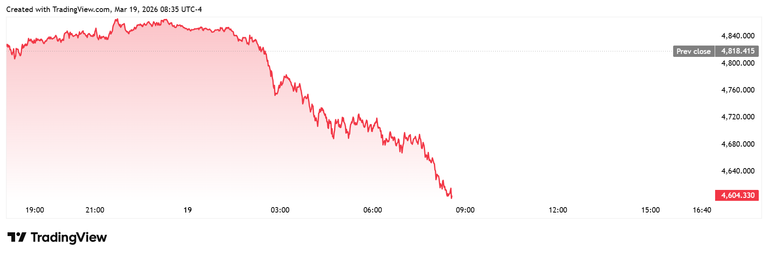
Gold prices steadied after early weakness on Thursday as fresh U.S. labour market data came in close to expectations but showed fewer new unemployment claims than economists had forecast. Spot gold last traded at $4,604.33 per troy ounce, down 4.44% on the session, even as bullion erased part of its earlier losses after the 8:30 a.m. data release.
For Indian investors, the move matters because U.S. labour data can shift expectations for Federal Reserve policy, U.S. Treasury yields, the dollar, and ultimately the rupee price of gold. When U.S. data stays firm, XAUUSD can face pressure, but any rebound in safe-haven demand can still support domestic bullion prices in INR terms.
What happened to gold prices after the U.S. jobless claims report?
Gold prices stayed under pressure but recovered from deeper losses after the U.S. weekly jobless claims report. Spot gold continued to decline immediately after the 8:30 a.m. release, then began erasing part of the session's earlier drop.
The Labor Department said initial claims for state unemployment benefits totaled a seasonally adjusted 205,000 for the week ending March 14. That was below the market expectation of 215,000 and lower than the previous week's unrevised reading of 213,000.
After the data, spot gold last traded at $4,604.33 per ounce, down 4.44% on the session. That left gold prices softer on the day, but no longer at their intraday lows.
Why did the market react this way?
The market reacted because lower-than-expected jobless claims pointed to a still-resilient U.S. labour market. A stronger labour backdrop can reduce expectations for rapid Federal Reserve easing, which tends to pressure non-yielding assets such as gold.
At the same time, the report was not dramatically stronger than forecast. That helped bullion recover some ground rather than extend its selloff aggressively.
Why did lower jobless claims matter for gold price today?
Lower jobless claims mattered because they signaled that fewer Americans filed for unemployment benefits than economists expected. That suggests the U.S. economy and labour market remain relatively firm, a factor that can keep bond yields and the U.S. dollar supported.
Gold usually struggles when traders think the Federal Reserve may keep interest rates higher for longer. Higher rates raise the opportunity cost of holding bullion, while a firmer dollar can make XAUUSD less attractive in the short term.
In this case, initial claims came in at 205,000, versus the 215,000 consensus forecast. Because the number beat expectations, it added a bearish macro signal for precious metals, even though the data was still broadly in line with a stable labour market backdrop.
What did the previous week's data show?
The previous week's initial jobless claims figure was 213,000 and was unrevised. That comparison reinforced the impression that layoffs remain contained rather than accelerating.
For gold traders, that matters because labour weakness often supports safe-haven buying and increases expectations of easier monetary policy. Thursday's report did not provide that kind of support.
What does the four-week moving average say about the U.S. labour market?
The four-week moving average showed labour market conditions remained steady. This measure is often treated as more reliable than the weekly headline number because it smooths out short-term volatility.
The four-week moving average for new claims came in at 210,750. That was below the previous week's revised average of 211,500 and also below expectations for 213,750.
Why do gold traders watch the four-week average?
Gold traders watch the four-week average because it offers a cleaner read on labour market momentum. If the average is falling or holding low, markets may conclude the U.S. economy is not weakening enough to force the Federal Reserve into faster rate cuts.
That kind of interpretation can cap gains in bullion and other precious metals. It also helps explain why gold prices remained negative on the session even after recovering from earlier losses.
What did continuing jobless claims show?
Continuing jobless claims showed that the number of people already receiving unemployment benefits edged higher. That suggested some softening beneath the surface, even though the initial claims figure looked stronger than expected.
Continuing claims were 1.857 million for the week ending March 7. That was slightly above expectations of 1.850 million and above the previous week's revised level of 1.847 million.
Does that change the outlook for bullion?
Not immediately, but it adds nuance to the labour market picture. Initial claims showed fewer new layoffs, while continuing claims indicated that some unemployed workers may be taking longer to find new jobs.
For gold, that mixed signal may help explain why prices did not keep falling sharply after the release. Traders saw enough strength to keep pressure on XAUUSD, but enough softness to prevent a deeper breakdown in sentiment.
How does this affect Indian gold investors?
Indian gold investors should watch how U.S. data shapes the dollar, Treasury yields, and Federal Reserve expectations, because those global drivers feed directly into domestic bullion prices. Even when spot gold softens in dollar terms, INR weakness can cushion the decline in local prices.
If strong U.S. labour data keeps the dollar firm, imported gold can remain expensive for Indian buyers. That is important for jewellery demand, gold ETFs, and physical bullion purchases across India.
What should Indian investors monitor next?
Indian investors should track whether upcoming U.S. macro data continues to show labour market resilience or begins to weaken more clearly. A stronger U.S. economy can pressure gold price momentum, while softer data could revive safe-haven demand and rate-cut expectations.
For now, the key watchpoint is whether spot gold can stabilize after trading at $4,604.33 per troy ounce despite a 4.44% session loss. If U.S. data stays firm, bullion may remain volatile; if labour indicators soften, gold could regain support quickly in both XAUUSD and INR terms.