# Gold Price Holds Near $4,542 as Hormuz Risk Premium Fades
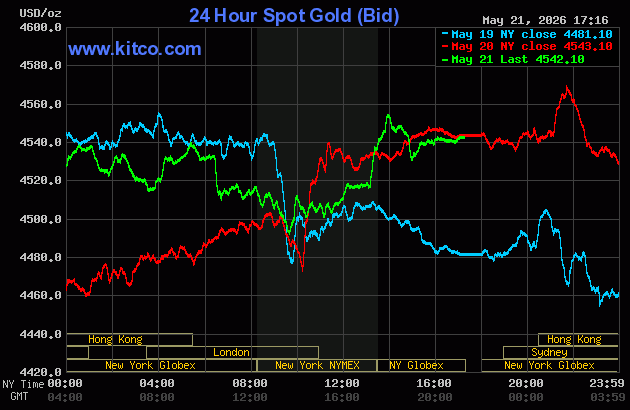
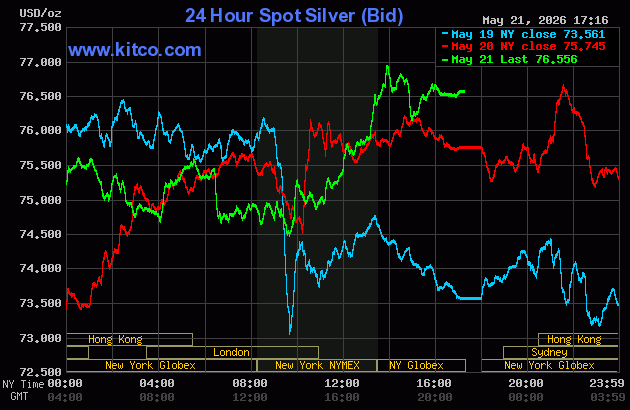
Spot gold held nearly flat on Thursday as easing oil prices and softer U.S. Treasury yields offset pressure from a stronger U.S. dollar. Spot silver outperformed, rising more than 1%, as markets unwound part of the geopolitical premium tied to the Strait of Hormuz.
For Indian investors, the move matters because changes in crude oil, U.S. yields and the dollar often feed directly into imported gold costs, rupee pricing and near-term bullion sentiment.
Why did gold price stay steady while silver rose on Thursday?
Gold stayed steady because supportive moves in crude oil and bond yields balanced the negative effect of a firmer U.S. dollar. Silver rose because broader risk sentiment improved while precious metals pricing remained supported by lower yields.
At the time of writing, spot gold traded near $4,542.40 per troy ounce, down 0.04% on the session. Spot silver traded near $76.655, up 1.03%.
The session showed a split across precious metals. Gold, or XAUUSD, found equilibrium as lower energy prices reduced inflation pressure and helped Treasury yields ease. Silver, which often benefits from both precious metals demand and growth-linked sentiment, moved higher.
What drove the shift in market sentiment around the Strait of Hormuz?
The main driver was a partial unwind of the geopolitical risk premium tied to the Strait of Hormuz. Markets reacted to signs that U.S.-Iran talks were moving toward a possible deal, even though major obstacles remain.
The Strait of Hormuz remains the key transmission channel from geopolitics into oil, interest rates and bullion. When traders see lower odds of a disruption, crude oil prices tend to fall, inflation fears ease and safe-haven demand for gold can soften.
However, the situation is not fully resolved. Iran’s uranium stockpile and Tehran’s position on a possible toll system in the strait remain sticking points. President Donald Trump has said the Strait of Hormuz should remain an international, toll-free waterway.
The market impact was mixed for gold price action. Gold lost some safe-haven support, but lower oil prices and lower yields helped limit downside pressure.
How did U.S. economic data affect gold and silver prices?
U.S. data sent an uneven signal, which kept markets cautious rather than directional. Labor data stayed firm, housing starts weakened, permits improved and regional manufacturing lost momentum.
Weekly jobless claims fell by 3,000 to 209,000 for the week ended May 16. The prior week was revised to 212,000.
In housing, April housing starts fell 2.8% to a 1.465 million seasonally adjusted annual rate. At the same time, building permits rose 5.8% to 1.442 million.
Manufacturing and services data also painted a mixed picture. The Philadelphia Fed manufacturing index fell to -0.4 in May from 26.7 in April. Meanwhile, flash U.S. manufacturing PMI rose to 55.3, services PMI slipped to 50.9 and the composite PMI held at 51.7.
For gold investors, this kind of mixed macro backdrop matters because it clouds the outlook for Federal Reserve policy. Firm labor conditions can keep yields elevated, while weaker factory activity and softer housing can support expectations for easier rates later, which is generally constructive for bullion.
How did oil, the U.S. dollar and Treasury yields shape bullion trade?
Oil and yields helped gold, while the U.S. dollar capped gains. That balance is the clearest reason spot gold stayed almost unchanged.
Brent crude fell sharply from near $109 in the morning to settle below $103, helping bond yields ease and allowing equity markets to recover from early losses. In the wider outside markets, Nymex WTI crude oil settled around $96.35 a barrel, while Brent crude settled near $102.58.
The U.S. dollar index was firmer, which typically pressures gold because bullion becomes more expensive for non-dollar buyers. Meanwhile, the yield on the benchmark 10-year U.S. Treasury note traded near the 4.6% area, but easing from earlier highs provided some support for precious metals.
For Indian investors, these cross-currents are crucial. A stronger U.S. dollar can pressure the Indian rupee and raise local gold prices even if international XAUUSD stays flat. Lower crude oil prices, on the other hand, can ease imported inflation risks for India and reduce one source of upward pressure on domestic rates and currency volatility.
What happened in U.S. stock markets, and why does it matter for gold?
U.S. equities closed higher as falling crude oil prices improved risk sentiment. Stronger equities can reduce immediate safe-haven demand for gold, though the effect is often temporary when yields are also easing.
The S&P 500 rose 0.2% to 7,445.72. The Dow Jones Industrial Average gained 0.6% to 50,285.66. The Nasdaq Composite added 0.1% to 26,293.10. The Russell 2000 rose 0.9% to 2,843.45.
These gains followed the reversal in crude prices. As Brent moved lower, energy equities softened, broad equities firmed and the inflation impulse looked less severe. That combination reduced the urgency for defensive positioning in safe-haven assets such as gold, while still supporting silver through improved broader sentiment.

What are the key gold price levels to watch next?
Gold bulls need a move back above the $4,550 to $4,600 resistance zone to regain control. Bears need a break below $4,489.30 to trigger a deeper pullback.
On the upside, spot gold’s next major resistance area sits between $4,550 and $4,600. If gold can sustain a break above that zone, the next targets are $4,660 and then $4,680.
On the downside, bears are watching for a break below $4,489.30. If that level gives way, the next downside targets are $4,470 and then $4,370.
Near-term levels are also clearly defined. First resistance is seen at $4,550 and then at $4,600. First support is seen at $4,530 and then at $4,489.30.
For Indian bullion buyers, these international levels can translate quickly into local price swings, especially if USD/INR moves sharply alongside global risk sentiment.
What are the key silver price levels to watch now?
Silver bulls need to reclaim the $77.24 to $78.00 zone for momentum to strengthen further. A break below $76.14 would shift the near-term advantage back to the bears.
Spot silver’s next upside target is a move back above $77.24 to $78.00. If silver clears that range, the next upside targets are $79.00 and then $85.00.
On the downside, the next bearish objective is a break below $76.14. If that happens, deeper downside targets sit at $75.19 and then $74.63.
Immediate resistance stands at $77.24 and then $78.00. Support is seen at $76.14 and then $75.19.
The next watchpoint for gold and silver traders is whether diplomacy around the Strait of Hormuz keeps pulling crude lower or whether fresh friction restores the safe-haven bid. Indian investors should also track USD/INR and U.S. Treasury yields closely, because those two variables can reshape domestic gold price moves even when global bullion looks calm.