# Gold Price Holds Gains After Jobs Beat as Silver Jumps 3.22%
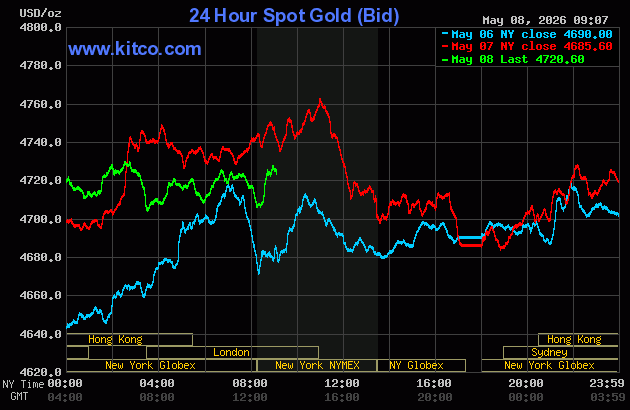
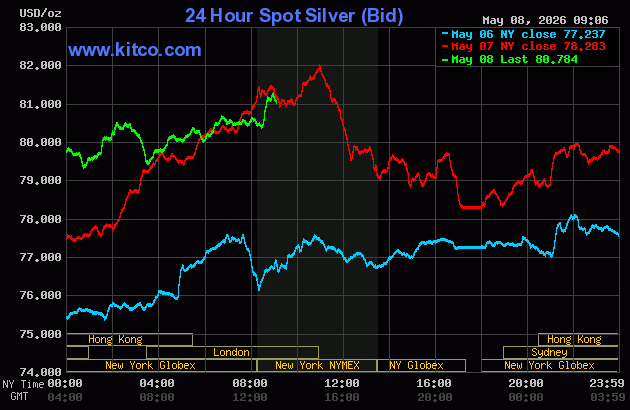
Gold prices stayed firm and silver prices surged in early U.S. trading on Friday even after the April U.S. payrolls report beat forecasts. Spot gold traded near $4,724.50 per troy ounce, up 0.75%, while spot silver climbed to $81.044, up 3.22% on the session.
For Indian investors, the move matters because stronger bullion prices, elevated crude oil and a volatile U.S. dollar can quickly feed into domestic gold rates in rupee terms. If the Indian rupee weakens against the U.S. dollar while XAUUSD remains strong, local gold prices can stay elevated even when global markets turn choppy.
Why did gold price hold gains after the U.S. jobs report?
Gold held gains because the April jobs report was stronger than expected, but not strong enough to fully erase expectations that the Federal Reserve could still cut rates later. The data reduced the chance of an immediate dovish shift, yet it kept the broader labor-market slowdown narrative alive.
The U.S. economy added 115,000 jobs in April, above the roughly 65,000 consensus estimate. The unemployment rate held at 4.3%.
That combination mattered for bullion. A softer labor market generally supports safe-haven and rate-cut expectations, but a stable unemployment rate limits pressure on the Federal Reserve to ease policy quickly.
The report did not deliver the weak nonfarm payrolls number that gold bulls had hoped to see before the U.S. open. Even so, gold remained resilient, suggesting traders still see support from macro uncertainty, geopolitical risks and a still-slowing U.S. economy.
What does the jobs data mean for Federal Reserve expectations and bullion?
The payrolls data suggests the Federal Reserve still has room to wait. That is mildly negative for gold in the very short term, but not enough to break the broader bullish structure in bullion.
Phillip Neuhart, head of market and economic research at First Citizens Wealth, described the labor backdrop as a “low-hire, low-fire equilibrium.” His assessment captures the current tension in the gold market.
How does a slower labor market support gold?
Slower hiring supports the possibility of future Federal Reserve rate cuts. Lower interest-rate expectations tend to help non-yielding assets such as gold because they reduce the opportunity cost of holding bullion.
Why does a stable labor market limit gold's upside?
A still-stable labor market lowers the urgency for Federal Reserve easing. If the Fed does not feel pressure to cut rates soon, U.S. Treasury yields can remain elevated and cap upside in XAUUSD.
For Indian gold buyers, this Fed dynamic is critical. U.S. rates influence the dollar, global capital flows and imported commodity prices, all of which can affect domestic bullion prices.
How are the U.S. dollar, Treasury yields and oil affecting gold today?
Gold traders are closely watching the post-payrolls reaction in the U.S. dollar, Treasury yields and crude oil after a highly volatile week. These outside markets are shaping short-term price direction for precious metals.
The U.S. dollar index was mixed to firmer after the payrolls report. The yield on the benchmark 10-year U.S. Treasury note was trading near the 4.4% area.
Higher yields usually create headwinds for gold because bullion does not pay interest. A firmer dollar can also pressure gold by making it more expensive for holders of other currencies.
At the same time, elevated oil prices can support inflation concerns and safe-haven demand, which helps explain why gold stayed firm despite the stronger-than-expected jobs data.
For Indian investors, the oil link is especially important. Higher crude prices can worsen India's import bill, pressure the rupee and indirectly support local gold prices.
Why are Middle East tensions supporting safe-haven demand for gold?
Renewed tension around the Strait of Hormuz is keeping geopolitical risk elevated and supporting safe-haven interest in gold and silver. The market is balancing stronger U.S. economic data against the risk of deeper disruption in energy flows.
The U.S.-Iran ceasefire came under renewed strain on Friday morning after U.S. forces and Iranian units exchanged fire in and around the Strait of Hormuz. Washington described its strikes as defensive, while Tehran accused the United States of violating the truce.
Iran has also moved to formalize control over shipping through the waterway with a new Persian Gulf Strait Authority. Regional security concerns widened further after the UAE reported intercepting Iranian missiles and drones.
Why does the Strait of Hormuz matter for bullion markets?
The Strait of Hormuz is the world's most important energy chokepoint. Any threat to shipping there can lift oil prices, increase inflation fears and trigger safe-haven buying in gold and other precious metals.
Diplomatic efforts remain active, but the latest U.S. proposal has reportedly met resistance from senior Iranian officials. As a result, the strait remains effectively constrained, oil is holding near the $100-a-barrel area, and shipping markets continue to price elevated transit risk.
What are the key crude oil levels investors should watch?
Crude oil remains elevated, reinforcing the inflation and geopolitical backdrop that can support bullion. The latest quoted prices show energy markets still pricing significant disruption risk.
The key outside markets showed Nymex WTI crude oil around $95.16 a barrel and Brent crude near $100.28 a barrel. Those levels remain important because sustained energy strength can keep inflation expectations sticky and complicate the Federal Reserve's policy path.
For India, Brent near $100.28 is especially relevant because the country imports most of its crude needs. Persistently high oil prices can pressure the rupee and add another layer of support to domestic gold prices.
What are the next technical levels for gold price?
Gold bulls still control the near-term chart, and the next upside levels are clearly defined. A break above resistance could open the door to another leg higher in XAUUSD.
Spot gold bulls' next upside price objective is to push prices above the $4,744.34 to $4,780.78 resistance zone. If gold sustains a move through that area, the next upside targets are $4,850.68 and then $4,891.54.

Where is gold resistance today?
First resistance stands at $4,744.34. The next resistance level comes at the 50-day moving average near $4,780.78.
Where is gold support today?
Bears' next near-term downside objective is a break below $4,685.27. Below that, deeper downside targets come in at $4,633.00 and then $4,541.88.
First support is seen at $4,685.27, followed by $4,633.00. Indian traders tracking MCX gold should watch these XAUUSD levels closely because they often shape short-term sentiment in domestic futures after adjusting for USD/INR moves.
What are the next technical levels for silver price?
Silver is showing stronger momentum than gold, and bulls are aiming for a breakout above the next major resistance area. The sharp move higher suggests traders remain constructive on precious metals despite stronger payrolls data.
Spot silver bulls' next upside price objective is to drive prices above the $83.00 area. If silver clears that level on a sustained basis, the next upside targets are $90.00 and then the $95.00 region.
Where is silver resistance today?
First resistance is seen at $83.00. The next major resistance level comes at $90.00.
Where is silver support today?
The next downside price objective for silver bears is a break below $72.00. Below that, deeper downside targets stand at $70.00 and then $61.00.
Next support is seen at $72.00 and then at $70.00.
Silver's outperformance also matters for Indian investors because domestic silver prices can react sharply when global spot silver rallies more than 3% in a single session. If geopolitical stress persists and industrial sentiment remains stable, silver could continue to outperform gold in the near term.
The immediate watchpoint for bullion investors is whether gold can clear $4,744.34 and whether silver can break $83.00 while oil stays near $100 and the 10-year U.S. Treasury yield hovers around 4.4%. For Indian markets, the added variables are the rupee's reaction to energy prices and whether domestic bullion premiums rise as global safe-haven demand stays firm.