# Gold Price Holds Above $4,700 as Silver Jumps on Mixed US Data
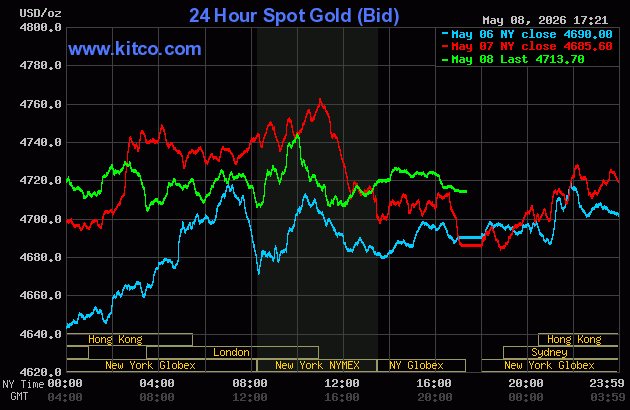
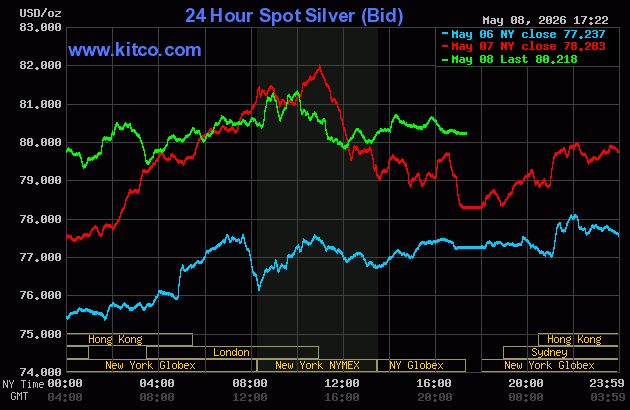
Spot gold and silver moved higher after fresh U.S. economic data painted a mixed picture for the Federal Reserve, supporting bullion without delivering a clear-cut signal for faster rate cuts. At the time of writing, spot gold traded near $4,716.20 per troy ounce, up 0.65% on the session, while spot silver stood at $80.300, up 2.57%.
For Indian investors, the move matters because a firm international gold price, a softer U.S. dollar index and elevated geopolitical risk can influence domestic bullion rates in rupee terms. If global XAUUSD stays above the $4,700 level, Indian gold buyers may continue to face high landed prices even if currency moves offer some relief.
Why Did Gold Price Rise After the Latest U.S. Data?
Gold price rose because the latest U.S. data mixed stronger labour-market signals with weaker consumer confidence and softer inflation expectations, a combination that kept safe-haven demand intact. That mix reduced immediate recession fears but still gave bullion enough support to hold above $4,700.
April nonfarm payrolls increased by 115,000, while the U.S. unemployment rate held steady at 4.3%. Job growth was concentrated in health care, transportation and warehousing, and retail trade, while federal government employment continued to decline.
At the same time, the preliminary May consumer sentiment index fell to 48.2 from 49.8 in April. Current conditions dropped 9.0% month over month, showing that households turned more cautious even as headline labour data stayed resilient.
Inflation expectations also cooled. One-year inflation expectations eased to 4.5% from 4.7%, while long-run inflation expectations slipped to 3.4% from 3.5%.
That combination mattered for precious metals. Stronger payrolls lowered near-term labour-market recession risk, but weaker sentiment and easing inflation expectations helped gold maintain its footing and kept the Federal Reserve policy path uncertain.
How Did Silver Outperform Gold?
Silver outperformed gold because investors kept buying precious metals while the gold-silver ratio eased and spot silver held above the key $80 level. At the time of writing, spot silver traded at $80.300, up 2.57%, far outpacing gold’s 0.65% gain.
The report said silver outperformed as the gold-silver ratio eased while spot silver stayed above $80. That suggests traders were willing to take on more exposure to industrial and monetary precious metals at the same time.
For Indian investors, silver’s stronger move can be especially relevant because domestic silver prices often react sharply to global momentum, rupee fluctuations and industrial demand expectations. A sustained rally in silver alongside firm gold prices could keep the broader precious metals complex well bid.
What Does the Mixed Data Mean for the Federal Reserve and Bullion?
The mixed U.S. data left the Federal Reserve path unclear, which supported gold but did not create an unambiguously bullish rate-cut setup. In short, the numbers were soft enough to help bullion, but not weak enough to guarantee imminent easing.
Payroll growth of 115,000 suggested the U.S. labour market is still generating jobs. The 4.3% unemployment rate also showed no further immediate deterioration.
But the drop in consumer sentiment to 48.2 and the decline in both short-term and long-term inflation expectations gave markets room to believe inflation pressure may be moderating. That helped keep gold price support intact because lower inflation expectations and softer sentiment can reduce pressure on the Federal Reserve to stay aggressively hawkish.
For XAUUSD traders, this creates a two-way macro setup. Stronger labour data can cap gains by delaying rate-cut expectations, while weaker confidence and softer inflation expectations can maintain demand for safe-haven assets such as gold.
How Is the U.S.-Iran Crisis Affecting Gold and Energy Markets?
The U.S.-Iran conflict is still supporting risk premiums across commodities because the ceasefire remains only nominally in place and the Strait of Hormuz is effectively closed or heavily constrained. That backdrop is helping preserve safe-haven interest in gold even as oil prices pulled back on hopes for a deal.
According to the source report, U.S. forces have struck Iranian military assets and disabled Iranian tankers in or near the Strait of Hormuz after reported attacks on U.S. warships. Iran has also seized the Ocean Koi in the Gulf of Oman and is asserting authority over commercial transits.
Commercially, Hormuz remains effectively closed or heavily constrained, which is keeping a material risk premium in energy markets. The impact goes beyond spot oil prices because tanker traffic is disrupted, while Gulf importers and Asian refiners face rerouting and supply-security costs.
Investors are therefore pricing a longer period of constrained access rather than a clean reopening. For India, that matters directly because India imports large amounts of crude and relies heavily on stable shipping routes. Higher energy costs can feed inflation, affect the rupee and indirectly support domestic gold demand as investors seek protection.
What Were the Key Outside Markets Telling Traders?
The main cross-market signals were supportive for precious metals, with the U.S. dollar index softer, crude oil elevated and the benchmark 10-year U.S. Treasury yield near 4.4%. Those conditions helped gold and silver stay firm despite the stronger payrolls number.
The report said Nymex WTI crude oil settled near $95.42 a barrel, while Brent crude was near $101.29. Elevated oil prices can reinforce inflation and geopolitical concerns, both of which tend to support safe-haven buying in bullion.
The U.S. dollar index was softer, which also aided gold price action because bullion becomes relatively cheaper for holders of other currencies when the dollar weakens. Meanwhile, the yield on the 10-year U.S. Treasury note was near the 4.4% area, a level that can limit upside in non-yielding assets but did not stop gold from holding gains.
For Indian bullion buyers, the combination of global gold strength, energy-market stress and foreign-exchange volatility remains crucial. Domestic gold price trends will depend not just on XAUUSD, but also on the rupee’s reaction to oil and dollar moves.
What Are the Key Gold Price Levels to Watch Now?
Gold bulls need a move above the $4,780 to $4,790 resistance zone to strengthen the upside structure, while bears need a break below $4,674 to regain near-term control. Those are the most important technical markers from the latest session.

Gold resistance levels
First resistance is seen at $4,749 and then at $4,780. If spot gold clears the $4,780 to $4,790 zone on a sustained basis, the next upside targets are $4,860 and then $4,880.
Gold support levels
First support is seen at $4,674 and then at $4,660. The next downside objective for bears is a break below $4,674, with deeper downside targets at $4,660 and then $4,635.
For Indian investors tracking MCX gold or imported bullion trends, these international price levels are important because a sustained global breakout or breakdown can quickly feed into domestic pricing.
What Are the Key Silver Price Levels to Watch Now?
Silver remains technically strong, but traders will watch whether it can hold above $80.00 and extend toward $85.00 and $86.00. Bears, meanwhile, need a break below $77.20 to trigger a deeper correction.
Silver resistance levels
The report identifies the next upside price objective for silver bulls as a drive back above the $78.00 to $79.00 area, with a move above that zone targeting $85.00 and then $86.00. It also lists first resistance at $80.00 and then $85.00.
Silver support levels
Next support is seen at $77.20 and then at $72.00. The next downside price objective for bears is a break below $77.20, with deeper downside targets at $72.00 and then $71.00.
Silver’s technical setup will matter for Indian investors because domestic silver tends to be more volatile than gold. If geopolitical stress persists and the Federal Reserve outlook stays mixed, traders will keep watching whether silver can sustain leadership in the precious metals space while gold defends the $4,700 level.