# Gold Price Holds $4,650 as Silver Sinks 4.6% on Yield Surge
Spot gold held above $4,650 per troy ounce on Thursday even as rising U.S. Treasury yields and a stronger U.S. dollar capped gains. Silver underperformed sharply, with spot silver falling 4.58% in its steepest one-day decline since March, showing how rate pressure can outweigh safe-haven demand even during heightened geopolitical stress.
For Indian investors, this mix matters because global bullion prices, the U.S. dollar, and crude oil all shape domestic gold rates in rupees. With oil elevated and the Strait of Hormuz under strain, imported inflation and currency moves could keep volatility high in the Indian gold market.
What happened to gold and silver prices on Thursday?
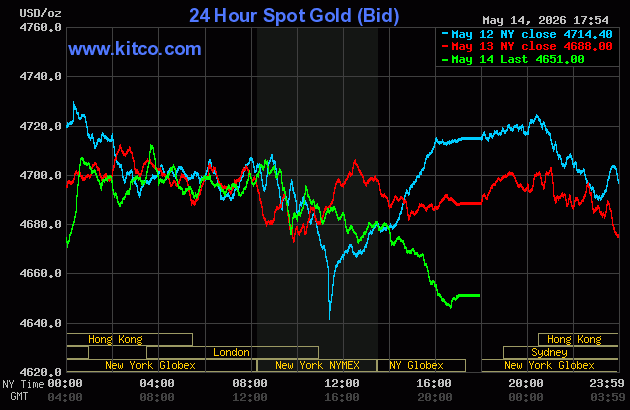
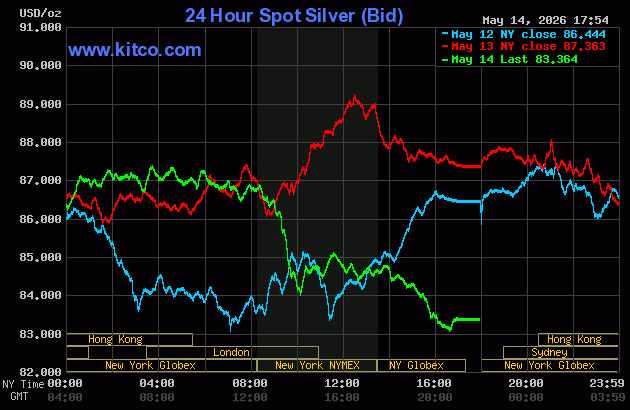
Gold edged lower, while silver dropped sharply. At the time of writing on Thursday, spot gold traded near $4,650.30 an ounce, down 0.80%, while spot silver traded at $83.360, down 4.58% on the session.
In futures trade, Comex gold for May delivery settled down 0.42% at $4,678.10 per troy ounce. Comex silver settled down 4.47% at $84.912 per troy ounce, marking its largest one-day drop since March.
The divergence shows that gold retained some safe-haven support, while silver behaved more like a growth-sensitive precious metal under pressure from higher yields and a firmer dollar.
Why did gold prices slip even with Strait of Hormuz tensions rising?
Gold slipped because rising Treasury yields and a stronger U.S. dollar offset safe-haven demand linked to the Strait of Hormuz. In other words, geopolitical fear supported bullion, but higher real-world holding costs limited upside for non-yielding assets like gold and silver.
The Strait of Hormuz remains the dominant geopolitical risk variable across energy, gold, and inflation-linked trades. A ship anchored 38 nautical miles northeast of Fujairah was seized and taken toward Iranian waters, while an Indian-flagged cargo ship sank near Oman after an attack.
Iran is pressing a sovereignty claim over the waterway, which carried roughly one-fifth of the world’s oil before the war. U.S. and Chinese officials have both said the strait must remain open.
How does the Strait of Hormuz affect bullion markets?
The impact is two-sided for gold. First, shipping risk and military tension increase safe-haven demand for gold and, to a lesser extent, silver.
Second, crude oil near the mid-$100s raises inflation concerns and keeps U.S. Treasury yields elevated. That matters because higher yields increase the opportunity cost of holding non-interest-bearing assets such as gold.
For broader markets, the immediate impact is clearest in crude oil, shipping insurance, global equities exposed to energy costs, and the U.S. dollar’s safe-haven bid.
What U.S. economic data shaped gold and silver today?
The U.S. data sent a mixed signal for precious metals. Consumer spending stayed firm, the labor market softened slightly, and interest rates remained high enough to pressure bullion.
April retail sales rose 0.5% to $757.1 billion after a revised 1.6% gain in March. Over a broader period, total February-through-April sales rose 4.4% from the same period a year earlier.
At the same time, initial jobless claims rose by 12,000 to 211,000 for the week ended May 9. Continuing claims rose by 24,000 to 1.782 million for the week ended May 2.
Why does mixed macro data matter for XAUUSD and silver?
Mixed macro data matters because it complicates the outlook for the Federal Reserve and for yields. Strong retail sales suggest resilient consumption, while higher jobless claims hint that the labor market is cooling at the margin.
That combination left the macro backdrop mixed for XAUUSD, silver, and the broader precious metals complex. Consumption held up, but rates stayed high enough to keep pressure on non-yielding assets.
How did the dollar, Treasury yields, oil, and stocks influence bullion?
Higher yields, a firmer dollar, and elevated oil prices created a difficult backdrop for gold and silver. Even though geopolitical risk usually helps safe-haven assets, these outside markets reduced the room for bullion to rally.
The yield on the benchmark 10-year U.S. Treasury note traded near the 4.5% area. The U.S. dollar index was firmer, which made dollar-priced gold and silver less attractive at the margin for international buyers.
Energy markets remained elevated. Nymex WTI crude oil traded near $100.93 a barrel, while Brent crude traded near $106.37.
U.S. equities, however, closed higher. The S&P 500 rose 0.8% to a record 7,501.24, the Dow Jones Industrial Average gained 0.7% to 50,063.46, and the Nasdaq Composite added 0.9% to 26,635.22.
What does this mean for Indian investors?
For Indian investors, elevated crude prices are especially important because India is a major oil importer. If oil stays high and the U.S. dollar remains firm, the INR gold price can stay supported even if international spot gold softens.
The Indian-flagged cargo ship incident near Oman also adds a direct India angle to the Strait of Hormuz story. Any prolonged disruption in shipping lanes can affect freight costs, imported inflation expectations, and rupee sentiment, all of which influence domestic bullion demand.
What are the key technical levels for gold price now?
Gold remains above a crucial support area, but bulls need a move back through resistance to regain momentum. The near-term technical setup shows a market trying to balance safe-haven demand against yield pressure.
Gold price resistance levels

Spot gold bulls’ next upside price objective is to push prices back above the $4,711 to $4,723 resistance zone. If gold achieves a sustained move through that band, the next upside target is $4,774.
First resistance is seen at $4,711 and then at $4,723.
Gold price support levels
Bears’ next near-term downside objective is a break below $4,686. If that support fails, deeper downside targets come in at $4,561.
First support is seen at $4,697 and then at $4,686.
What are the key technical levels for silver price now?
Silver suffered a sharper technical setback than gold. Bulls now need to reclaim nearby resistance quickly to stabilise momentum after the session’s 4.58% decline.
Silver price resistance levels
Spot silver bulls’ next upside price objective is to drive prices back above the $84.00 to $84.90 area. A move above that zone would target $85.75 and then $87.37.
First resistance is seen at $84.00 and then at $84.90.
Silver price support levels
The next downside price objective for silver bears is a break below $83.15. If silver falls through that level, deeper downside targets come in at $82.25 and then $80.63.
Next support is seen at $83.15 and then at $82.25.
For now, Indian investors should watch three catalysts closely: whether the 10-year U.S. Treasury yield stays near 4.5%, whether Brent crude remains above $106, and whether tensions in the Strait of Hormuz escalate further. Those factors are likely to determine whether gold price can retest $4,711-$4,723 or whether silver extends its slide toward $83.15 and below.