# Gold Price Hits Session Highs After ISM Services PMI Miss
Gold prices climbed after weaker-than-expected U.S. services data reinforced signs of slowing momentum in the world’s largest economy. For Indian investors, softer U.S. macro data can support bullion by pressuring bond yields and the U.S. dollar, even as elevated oil prices remain a separate inflation risk for gold and the rupee.
Why did gold price rise after the ISM Services PMI report?
Gold price rose because the April ISM Services PMI came in slightly below expectations, prompting a fresh safe-haven bid and helping XAUUSD reach session highs. The weaker data suggested that U.S. growth momentum in the services sector eased, which can improve the appeal of non-yielding bullion.
The Institute for Supply Management said on Tuesday morning that its Services Purchasing Managers Index registered 53.6 in April, down from 54 in March. Economists had expected a reading of 53.7, so the print was marginally weaker than forecast.
In ISM diffusion indexes, readings above 50 indicate economic expansion, while readings below 50 point to contraction. The farther an indicator moves above or below 50, the stronger or weaker the rate of change.
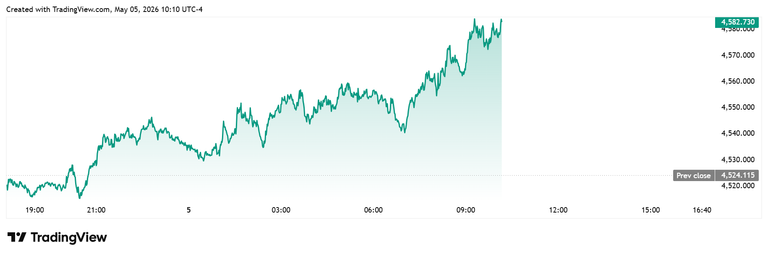
Following the 10 a.m. data release, gold prices moved to fresh session highs. Spot gold was last quoted at $4,582.81 per ounce, up 1.30% on the day.
For Indian investors tracking international bullion markets, this kind of reaction matters because a softer U.S. data print can quickly feed into global gold price expectations, imported bullion costs, and domestic price moves in rupee terms.
What did the April ISM Services PMI reveal about the U.S. economy?
The April ISM Services PMI showed that the U.S. services sector was still expanding, but growth slowed modestly from the previous month. That combination matters for gold because it signals resilience without removing concerns about an economic slowdown.
Steve Miller, Chair of the ISM Services Business Survey Committee, said April’s Services PMI marked the fourth month in a row of an increase in the 12-month PMI average. That average rose by 0.8 percentage point, from 51.7 percent in December 2025 to 52.5 percent currently.
That trend indicates the broad services economy has remained in growth territory over the past year. But the latest monthly moderation still gave traders a reason to add exposure to precious metals, especially when gold is already trading as both an inflation hedge and a safe-haven asset.
What parts of the ISM report mattered most for bullion traders?
The most important details for bullion traders were the drop in new orders, continued price pressure, and weaker employment readings. Those components suggested slower underlying momentum even though headline activity remained in expansion.
How did business activity perform?
The Business Activity Index stayed in expansion territory and actually improved in April. It increased 2 percentage points to 55.9 percent, up from 53.9 percent in March.
That improvement showed that current activity levels remained solid. Still, gold traders focused more heavily on the forward-looking and inflation-sensitive parts of the report.
What happened to employment in the services sector?
The Employment Index contracted for the second month in a row, signaling continued softness in service-sector hiring. It came in at 48 percent in April, which was a 2.8-percentage point increase from 45.2 percent in March.
Even with that monthly improvement, a reading below 50 still indicates contraction. Persistent labor-market softness can strengthen the case for defensive positioning in gold if investors begin to price in slower U.S. growth.
Why was the drop in new orders significant?
The New Orders Index posted a sharp decline, which pointed to weaker demand ahead. Steve Miller said increases in the Business Activity, Supplier Deliveries, and Employment indexes were more than offset by a 7.1-percentage point drop in the New Orders Index.
That slide is important because new orders often act as an early signal for future business momentum. When orders weaken, investors often reassess growth expectations, which can support safe-haven demand for bullion.
How are oil prices and supply-chain pressures affecting the gold outlook?
Higher oil and fuel costs are keeping inflation pressures alive across supply chains, and that mix can remain supportive for gold. Inflation linked to energy costs can boost demand for precious metals as a hedge, even if it also complicates the interest-rate outlook.
Steve Miller said the Prices Index was flat but remained above 70 percent, reflecting sustained higher oil and fuel costs. He also said the Supplier Deliveries Index showed slower performance than in March, coming in 3.9 percentage points above its 12-month average.
Miller added that market commentary about businesses ordering early to get ahead of future price increases appeared to apply more to March than April. Even so, he noted that the Backlog of Orders Index remained in expansion territory and stayed well above its 12-month average of 46.4 percent.
He also highlighted comments from survey respondents who said they had not yet seen petroleum price increases impacting petroleum-related products. According to Miller, that means the market should expect continued elevated readings for the Prices Index for several months, regardless of when the conflict in Iran ends, because those costs will continue moving through global supply chains.
For Indian investors, this is especially important. Higher oil prices can pressure India’s import bill and weigh on the rupee, which can lift local gold prices even if international spot gains remain moderate. That means Indian bullion buyers need to watch both XAUUSD and USD/INR.
What does this mean for Indian gold investors now?
The immediate signal is that gold remains supported by a mix of softer U.S. data and persistent inflation risks from energy. Indian investors should treat this as a reminder that bullion can benefit when growth concerns and cost pressures rise together.
Spot gold at $4,582.81 per troy ounce and up 1.30% on the day shows the market responded quickly to the ISM release. If U.S. macro data continues to soften while oil-driven inflation stays elevated, gold price volatility could remain high.
For investors in India, the next watchpoints are clear: whether U.S. services and labor data weaken further, whether oil prices keep feeding through global supply chains, and whether rupee moves amplify imported bullion costs. Those factors will likely shape the near-term outlook for gold price, silver, and the broader precious metals complex.