
# Gold Price Hits Session High as US Consumer Sentiment Slumps
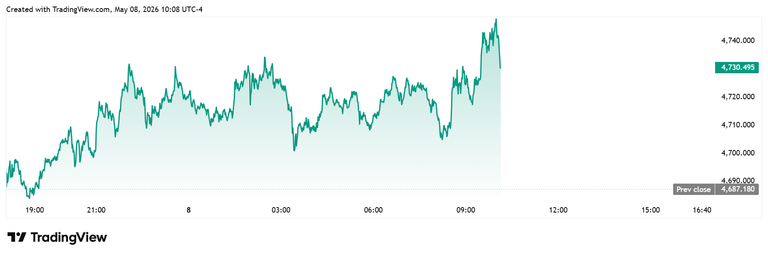
Gold prices climbed on Friday after weak U.S. consumer sentiment data and slightly softer inflation expectations supported safe-haven demand. Spot gold briefly hit a session high of $4,749.58 per troy ounce at the 10 a.m. EST data release and was last trading at $4,730.42, up 0.92% on the day.
For Indian investors, the move matters because weaker U.S. sentiment can support global bullion prices, while any parallel moves in the rupee-dollar exchange rate can amplify domestic gold rates in INR.
Why did gold price rise after the U.S. consumer sentiment data?
Gold price rose because the latest U.S. data showed weaker consumer confidence and a modest easing in inflation expectations, which helped keep bullion near session highs. Softer sentiment can reinforce economic caution and support safe-haven interest in XAUUSD.
The University of Michigan said on Friday that its preliminary Consumer Sentiment Index for May came in at 48.2. That was weaker than the economist consensus forecast of 49.5 and below April’s final reading of 49.8.
After the release at 10 a.m. EST, spot gold jumped to $4,749.58. It later traded at $4,730.42 per ounce, still holding a 0.92% gain for the day.
What did the University of Michigan survey show?
The survey showed U.S. consumers remained deeply pessimistic, with sentiment near lows last seen in 2022. The details also pointed to rising household stress around prices, personal finances and major purchases.
According to Joanne Hsu, Director of the Surveys of Consumers, consumer sentiment was “essentially unchanged this month,” but still came in 1.6 index points below April’s reading and remained comparable to the trough seen in June 2022.
Hsu said the expectations index edged higher, but current conditions fell back about 9%. She attributed that decline to growing concerns about high prices, both in relation to personal finances and buying conditions for major purchases.
She also said real income expectations continued a decline that began in March. In addition, about one-third of consumers spontaneously mentioned gasoline prices, while about 30% mentioned tariffs.
How did inflation expectations change in May?
Inflation expectations eased slightly in May, but they remained elevated compared with earlier readings. That combination matters for gold because lower inflation expectations can calm some rate fears, while still-high price expectations keep economic anxiety alive.
Joanne Hsu said year-ahead inflation expectations softened from 4.7% in April to 4.5% in May. Even after that decline, the May reading stayed well above the 3.4% level seen in February, before the start of the Iran war.
She added that the current level also exceeds all 2024 readings and remains above the 2.3% to 3.0% range seen in the two years before the pandemic.
Longer-term inflation expectations also moved lower. Long-run inflation expectations slipped from 3.5% in April to 3.4% in May.
For comparison, Hsu noted that in 2024, long-run inflation expectations ranged between 2.8% and 3.2%. In 2019-2020, they were consistently below 2.8%.
What is driving weak U.S. consumer sentiment right now?
High fuel costs and unresolved geopolitical stress are the main forces hurting U.S. consumer sentiment. That backdrop can support gold as investors look for protection against uncertainty and persistent cost pressures.
Hsu said consumers continue to feel “buffeted by cost pressures,” led by soaring prices at the pump. She also warned that Middle East developments are unlikely to improve sentiment in a meaningful way until supply disruptions are fully resolved and energy prices fall.
The survey also showed how broad the pressure has become. Households are not only worried about inflation in general, but also about the direct hit from gasoline and the impact of tariffs on future costs.
What does this mean for Indian gold investors?
For Indian investors, stronger global gold prices can lift local bullion rates, especially if the Indian rupee weakens against the U.S. dollar. A firm international gold price near $4,730 per ounce can translate into higher domestic prices for jewellery buyers, traders and long-term savers.
Indian investors should also watch the interaction between XAUUSD, crude oil and USD/INR. If energy prices stay elevated because of Middle East supply concerns, India’s import bill and inflation outlook could remain under pressure, which may keep domestic interest in safe-haven assets such as gold and other precious metals strong.
The next key watchpoint is whether future U.S. data confirm that consumer demand is weakening while inflation expectations remain above pre-pandemic norms. If that pattern holds, bullion could stay supported, and Indian investors may see global gold price strength feed through into local INR prices.