# Gold Price Firms as Hormuz Risk Lifts Bullion, Silver Jumps
Spot gold and spot silver rose in early U.S. trading on Tuesday as bargain hunting emerged after Monday’s sharp futures-led selloff. Elevated crude oil prices, Strait of Hormuz tensions, a firmer U.S. dollar, and steady U.S. Treasury yields kept inflation fears and Federal Reserve rate risks in focus for bullion traders.
For Indian investors, the rebound in global gold price action matters because higher international bullion prices can support domestic gold rates, especially when geopolitical stress keeps safe-haven demand alive. A firmer U.S. dollar can also influence the rupee and raise the landed cost of imported gold in India.
Why did gold prices rise today?
Gold prices rose because traders stepped in to buy after Monday’s steep decline, while geopolitical concerns around the Strait of Hormuz kept safe-haven interest intact. The rebound was modest but notable given that the U.S. dollar index remained firm and bond yields stayed elevated.
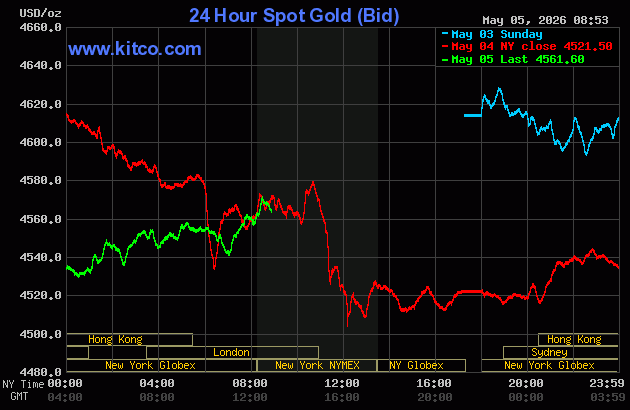
At the time of writing, spot gold traded near $4,563.30 per troy ounce, up 0.92% on the session. Spot silver traded at $73.800 per troy ounce, up 1.65%.
Monday’s selloff had created the setup for that bounce. May gold futures settled down $110.40, or 2.38%, at $4,519.50 an ounce, while May silver futures fell $2.879, or 3.79%, to $73.072 an ounce.
Thin holiday trading amplified Monday’s move. Markets in China, Japan, and the U.K. were affected by holidays, which reduced liquidity and made price swings more pronounced.
How is the Strait of Hormuz risk affecting gold and silver?
The Strait of Hormuz risk is supporting gold indirectly through energy markets. Traders are attaching the main geopolitical premium to crude oil rather than fully pricing it into bullion, but higher oil still feeds inflation concerns and strengthens the case for safe-haven buying.
Brent crude for July delivery traded near $112.73 a barrel, down 1.49% on the session. WTI crude for June delivery traded near $103.94 a barrel, down 2.33%.
Even though oil eased on Tuesday, prices remained elevated after Monday’s spike tied to Strait of Hormuz developments. That matters for gold because sustained energy strength can keep inflation pressure alive, complicate the Federal Reserve’s rate path, and limit downside in precious metals.
For Indian investors, higher Brent crude can widen imported inflation risks and pressure the Indian rupee if oil stays elevated. That combination often becomes relevant for domestic gold prices because India imports most of its bullion and pays in dollars.
What macroeconomic data are traders watching this week?
Traders are watching U.S. labor and services-sector data closely because these releases can reshape expectations for Federal Reserve interest rates. Higher-for-longer rate expectations typically pressure non-yielding assets like gold, while weaker data can revive support for XAUUSD.
The immediate calendar on Tuesday includes the March JOLTS report at 10:00 a.m. ET, the ISM Services PMI at 10:00 a.m. ET, remarks from Federal Reserve Vice Chair for Supervision Michelle Bowman at 10:00 a.m. ET, and comments from Federal Reserve Governor Michael Barr at 12:30 p.m. ET.
The week’s main U.S. macro event is Friday’s April employment report. That payrolls release could set the tone for gold, silver, the U.S. dollar, Treasury yields, and broader precious-metals sentiment.
What are the key outside markets signalling for bullion?
The outside markets show a mixed backdrop for bullion. Oil remains elevated from a geopolitical standpoint, the U.S. dollar index is firmer, and the benchmark U.S. 10-year Treasury yield is holding near 4.4%.
A firmer dollar usually makes gold more expensive for non-U.S. buyers and can cap gains in XAUUSD. At the same time, elevated yields increase the opportunity cost of holding non-interest-bearing bullion.
Still, gold has held firm despite those headwinds, which suggests traders are balancing rate pressure against geopolitical risk and post-selloff bargain hunting. That resilience is important for Indian market participants tracking whether global bullion can sustain support above recent technical levels.
What are the key technical levels for spot gold now?
Spot gold is consolidating after Monday’s sharp selloff, and traders are now focused on whether bulls can reclaim the nearby resistance band. A break above that zone would improve the short-term technical picture.
Gold resistance levels
The next upside objective for bulls is a move above the $4,568 to $4,615 resistance zone. If spot gold clears that area, the next upside targets come in at $4,630.70 to $4,670.
First resistance is seen at $4,568 and then at $4,615.
Gold support levels
The bears’ next near-term downside objective is a break below $4,502.40. If gold slips below that level, deeper downside targets are $4,485 and then $4,450.
First support is seen at $4,502.40 and then at $4,485.
For Indian investors, these global spot levels matter because they can influence near-term direction in MCX gold and local jeweller pricing, especially if USD/INR also moves sharply.

What are the key technical levels for spot silver now?
Spot silver is also trying to recover, but it faces a clearly defined resistance band. The next move will likely depend on whether buyers can push prices through the upper edge of that zone.
Silver resistance levels
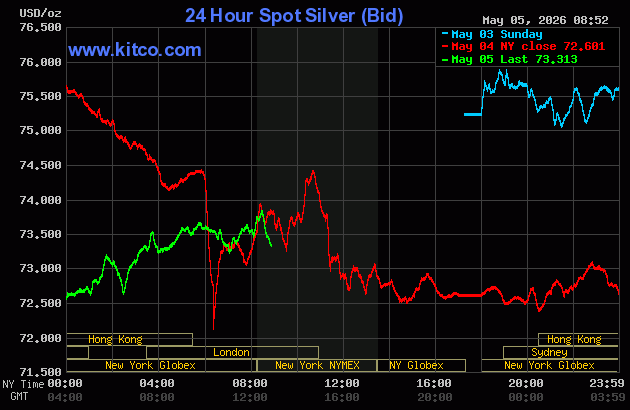
Spot silver bulls’ next upside price objective is to drive prices above the $73.80 to $75.00 resistance zone. If silver breaks above that band, the next target is $76.12.
First resistance is seen at $73.80 and then at $75.00.
Silver support levels
The next downside objective for bears is a break below $72.10. If that support fails, deeper downside targets are $71.00 and then $70.00.
Next support is seen at $72.10 and then at $71.00.
Silver often shows higher volatility than gold, so Indian investors in bullion, coins, bars, ETFs, or MCX contracts may want to watch these levels closely.
Gold and silver now head into a data-heavy stretch with the U.S. labor market report on Friday as the main watchpoint. If oil stays elevated, the dollar remains firm, and Treasury yields hold near 4.4%, precious metals could stay volatile, with global price moves likely feeding quickly into India’s gold market through both international bullion rates and rupee sensitivity.