
# Gold Price Falls After US Jobless Claims Hit 210,000
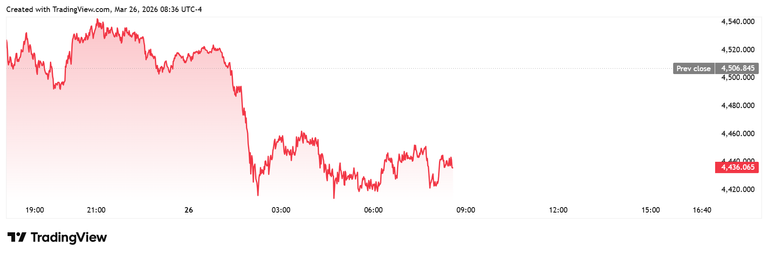
Gold prices slipped on Thursday after fresh U.S. labour market data matched expectations rather than delivering a clear downside surprise for the dollar or bond yields. Spot gold traded near its session low after the 8:30 a.m. data release and was last seen at $4,436.19 per troy ounce, down 1.57% on the day.
For Indian investors, the move matters because U.S. macro data often drives the XAUUSD gold price, which then feeds into domestic bullion rates after adjusting for the USD/INR exchange rate, import costs and local premiums.
Why did gold price fall after the U.S. jobless claims data?
Gold price fell because the U.S. weekly jobless claims report came in exactly in line with forecasts, giving traders little reason to aggressively price in a weaker U.S. economy or faster Federal Reserve easing. With no major downside surprise in the labour market, bullion stayed under pressure near session lows.
The U.S. Labor Department said initial claims for state unemployment benefits rose to a seasonally adjusted 210,000 in the week ending March 21. That figure matched the consensus estimate of 210,000.
The previous week's initial claims number was 205,000, and that figure was unrevised. Because the release broadly met expectations, the data did not trigger a strong safe-haven bid for gold.
Immediately after the 8:30 a.m. release, spot gold continued to trade close to the session low of $4,412.44. It later changed hands at $4,436.19 per ounce, showing a 1.57% daily loss on the chart.
What did the weekly jobless claims report actually show?
The report showed a stable U.S. labour market rather than a sharp deterioration. That stability limited support for gold, even though claims rose modestly from the previous week.
Initial jobless claims
Initial jobless claims came in at 210,000 for the week ending March 21. Economists had expected 210,000, so the number landed exactly on target.
The prior week's reading held at 205,000 with no revision. That meant the latest increase was small and did not materially change the market's view of U.S. labour conditions.
Four-week moving average
The four-week moving average pointed to a labour market that remains steady overall. This measure often carries extra weight because it smooths out weekly volatility.
The four-week moving average for new claims was 210,500, compared with the previous week's unrevised 210,750. Expectations had been for 212,000, so the average came in slightly lower than forecast.
That softer-than-expected moving average suggested labour conditions were not weakening fast enough to spark a strong rally in precious metals.
Continuing jobless claims
Continuing jobless claims showed fewer people receiving benefits than economists expected. That reading also reinforced the view that the U.S. jobs market remains relatively resilient.
Continuing jobless claims were 1.819 million in the week ending March 14. Economists had expected 1.850 million.
The previous week's level was revised to 1.851 million. Even though the latest figure was reported as above that revised prior level in the source report, the key market takeaway was that continuing claims came in below expectations.
How does in-line U.S. labour data affect gold prices?
In-line labour data usually weighs on gold when traders were hoping for a softer reading that could push the Federal Reserve toward rate cuts. Gold tends to perform better when economic data weakens enough to pull down Treasury yields and the U.S. dollar.
When jobless claims match forecasts, markets often see no urgent reason to reprice the Fed outlook. That can keep real yields firm and cap gains in non-yielding assets such as bullion.
Gold also reacts quickly because macro traders use labour data as a live signal for U.S. growth and monetary policy. In this case, the claims data did not offer a fresh catalyst for safe-haven buying in XAUUSD.
For precious metals traders, that means the gold price remains sensitive not just to whether data rises or falls, but to whether it beats or misses expectations.
What does this mean for Indian gold investors?
Indian gold investors should watch both the international gold price and the rupee because domestic bullion prices depend on both. A drop in spot gold to $4,436.19 per ounce can ease local price pressure, but a weaker rupee can offset part of that decline.
If the USD/INR exchange rate rises, Indian buyers may not see the full benefit of a softer global gold price. If the rupee holds steady or strengthens, the international pullback can translate more directly into lower domestic rates for jewellery buyers and investors in coins, bars and digital gold.
Short-term traders in India should also note the intraday low of $4,412.44, as global support and resistance levels in XAUUSD often influence sentiment in the local bullion market. Longer-term investors may focus more on whether U.S. labour data continues to stay firm, since that can shape the Federal Reserve path and, in turn, the trend for gold.
What should gold traders watch next?
Gold traders should watch upcoming U.S. labour and inflation data because the Federal Reserve outlook remains the main macro driver. If future reports show a clearer slowdown than the latest jobless claims release, bullion could regain safe-haven momentum.
For now, the immediate signal is that the U.S. labour market data did not materially weaken. As long as claims stay near 210,000, the four-week average stays around 210,500, and continuing claims remain close to 1.819 million, gold may struggle to find a strong new upside catalyst from labour data alone.
Indian investors should track three variables together: the international gold price, the U.S. dollar, and USD/INR. That combination will likely determine whether this pullback in global bullion becomes a buying opportunity in the domestic market.