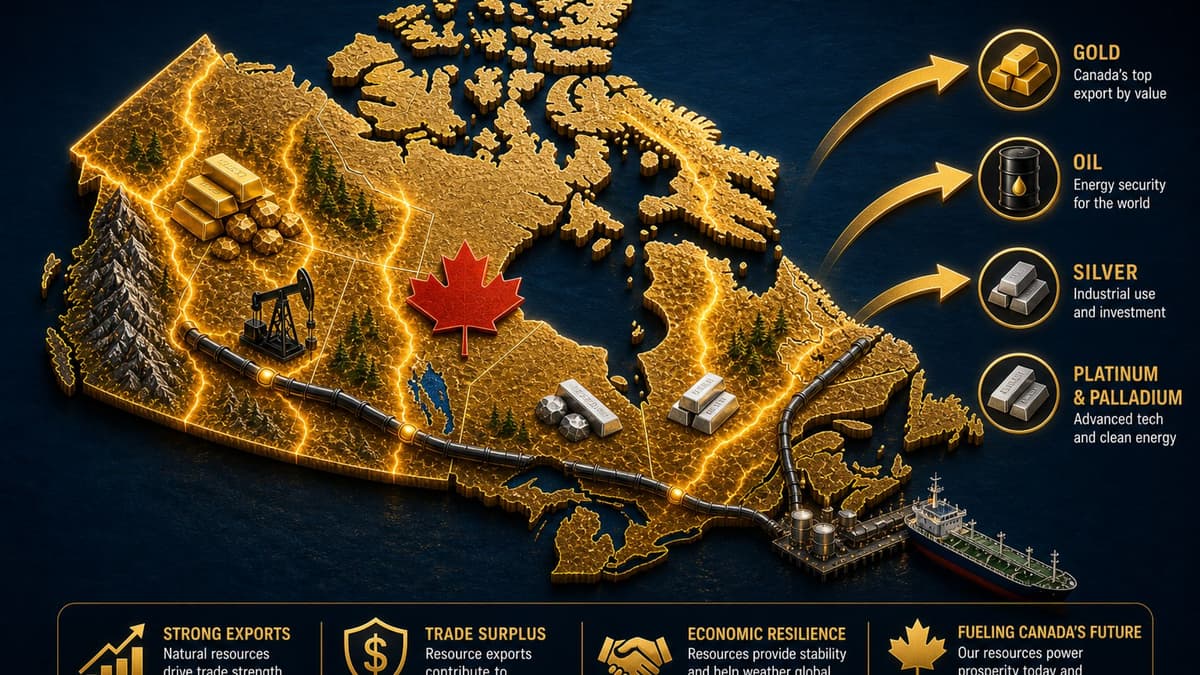
Canada’s trade balance swung back into surplus in March as elevated gold prices, stronger precious metals exports, and surging oil shipments offset broader global uncertainty. For Indian investors, the report matters because it shows how geopolitical shocks are simultaneously supporting bullion, energy, and commodity-linked currencies—factors that can feed into global gold price trends and rupee-denominated gold rates.
What pushed Canada’s trade balance back into surplus in March?
Canada returned to a trade surplus in March because exports rose sharply while imports declined. According to Statistics Canada, the country posted a C$1.8 billion trade surplus in March, its first surplus in six months.Total exports increased 8.5% to C$72.8 billion in March, the highest level since January 2025. That marked a sharp reversal from February’s C$5.1 billion trade deficit, which was the largest on record since August 2025.
Imports fell 1.6% after surging in February. The decline came mainly from consumer goods, which dropped 3.9%, and aircraft and other transport equipment, which fell 12.8%.
How did gold and precious metals drive Canada’s exports higher?
Precious metals were one of the biggest reasons Canada’s trade position improved. Statistics Canada said a 24% increase in precious metals demand helped drive the surplus.Exports of precious metals including gold, silver, and platinum made the largest contribution to the monthly change in that category. Those exports jumped 37.7% to C$3 billion, with most of the shipments going to the United Kingdom.
This surge highlights how strong global demand for safe-haven assets and refining flows can boost trade data when gold price levels stay elevated. For investors tracking XAUUSD, the report reinforces that physical and institutional demand for precious metals remains firm even during broader macro stress.
Why did oil exports also surge in March?
Oil exports climbed because the war in Iran triggered a global energy supply shock and pushed crude prices higher. In March, Canada’s oil exports rose about 15.6% to C$17.1 billion, the highest level since September 2022.Canada benefited from the sharp jump in global crude oil prices as energy markets reacted to supply disruption fears tied to the conflict in Iran. While oil has dominated recent market moves, the trade data shows that both energy and precious metals have acted as major supports for Canada’s export earnings.
For Indian investors, this matters because rising oil prices can pressure India’s import bill and weaken the Indian rupee, which can lift domestic gold prices in INR even if international gold prices in US dollars per troy ounce remain stable.
What are economists saying about Canada’s trade outlook?
Economists say Canada has managed current trade shocks relatively well, but uncertainty remains high. The key risks are upcoming CUSMA/USMCA negotiations and the broader impact of Middle East tensions on global demand and household costs.Economists at RBC said: “Significant trade uncertainty remains, with negotiations on CUSMA renewal likely to intensify in coming months, but we continue to expect, as a base case, that a more stable U.S. tariff backdrop in 2026 (albeit still at significantly higher tariff rates for some products) will leave trade as less of a headwind to growth than it was in 2025.”
RBC added: “The conflict in the Middle East is raising costs for households both in Canada and abroad, but the surge in net energy exports from higher oil prices is also significantly increasing revenues flowing into oil-producing regions. Our base-case outlook for the economy expects that, coupled with the lagged impact of earlier Bank of Canada interest rate cuts and higher government spending plans, will support further improvement in per-person (and per-worker) economic conditions in the year ahead.”
That view suggests policymakers and markets are now balancing two opposing forces: stronger commodity revenues on one side, and persistent trade and inflation uncertainty on the other.
What did BMO Capital Markets say about future risks?
Shelly Kaushik, Senior Economist at BMO Capital Markets, said Canada’s trade advantage is real, but it may not be permanent. She noted that the current benefit is closely tied to Canada’s role as an energy supplier while regional shipping disruption persists.Kaushik said: “The March trade figures highlight Canada’s relative advantage as an energy supplier while the Strait remains closed. While that support will remain until the Middle East conflict is resolved, the pace of global non-energy demand and the future of the USMCA remain key sources of uncertainty.”
Her comments underline that commodity-led resilience can help in the short term, but broader non-energy demand will still determine how durable the recovery becomes.
What does this mean for gold prices and central bank demand?
Analysts said gold still has strong underlying support, especially from central banks, even though oil has dominated financial markets since the war in Iran began. That means the medium-term outlook for bullion remains supported by official-sector buying and safe-haven demand.At the same time, analysts said retail investment demand for gold has been dampened by higher oil prices. The reason is that expensive energy is fueling inflation fears, which in turn are pushing central banks toward a neutral, wait-and-see stance on monetary policy.
That policy shift matters for XAUUSD because expectations for interest rates strongly influence non-yielding assets such as gold. If central banks delay rate cuts due to inflation pressure from oil, short-term upside in gold could become more uneven even if structural demand from central banks remains intact.
For Indian investors, the key watchpoint is the interaction between global gold prices, crude oil, and the rupee. If geopolitical tensions keep oil elevated and central banks cautious, domestic gold rates could stay supported through both international bullion demand and currency effects in the months ahead.