# Gold Price Breaks Below $4,600 as Dollar and Yields Surge
Gold prices fell sharply in early U.S. trading on Friday as a stronger U.S. dollar, higher Treasury yields and rising oil-driven inflation fears outweighed safe-haven demand linked to the Strait of Hormuz. For Indian investors, the drop in global bullion prices may offer near-term relief, but elevated crude oil and currency volatility could still keep domestic gold rates supported in rupee terms.
Why did gold prices fall below $4,600 today?
Gold fell because traders pulled back expectations for near-term Federal Reserve rate cuts after a fresh run of U.S. inflation data, while the U.S. dollar index stayed firm above 99 and the 10-year U.S. Treasury yield traded near 4.5%.
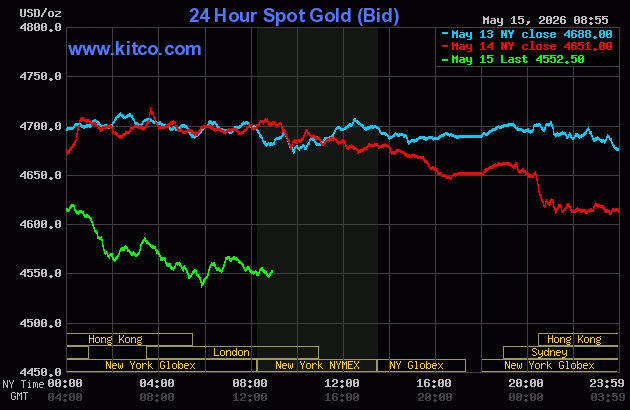
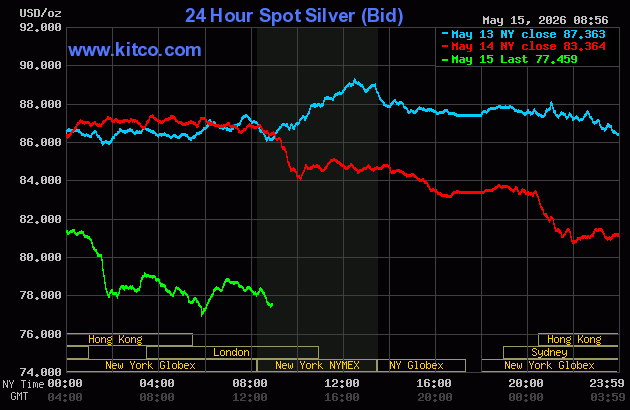
At the time of writing on Friday, spot gold traded near $4,550.00 per troy ounce, down 2.17% on the session. Spot silver performed even worse, trading at $77.970, down 6.47%.
Gold’s decline extended into a four-session slide after April CPI, PPI and import-price data all fed into market expectations before the U.S. open. That data made traders less willing to price in near-term easing from the Federal Reserve, which hurt non-yielding assets such as gold and silver.
Silver saw the heaviest pressure. The day’s range widened sharply to $76.71 to $84.00, and momentum-driven selling pushed silver through the key $80 level.
How is the Strait of Hormuz affecting gold and silver prices?
The Strait of Hormuz is supporting safe-haven demand, but it is also pushing oil prices higher, which in turn lifts inflation expectations, supports bond yields and pressures gold. That is why the geopolitical backdrop is helping and hurting bullion at the same time.
The U.S.-Iran ceasefire has held for more than one month, but shipping traffic remains far below normal levels. One shipping-analytics count showed only 10 vessel crossings in a 24-hour period, compared with roughly 140 daily crossings before the conflict.
U.S. President Donald Trump and Chinese President Xi Jinping agreed that Iran cannot have nuclear weapons and that the Strait of Hormuz must fully reopen. However, Trump’s warning that patience with Tehran is running out pushed crude oil prices higher.
For gold, the setup remains two-sided. The unresolved regional risk supports safe-haven buying, but $100-plus WTI crude and stronger Brent crude reinforce inflation concerns, which raise yields and reduce the appeal of non-interest-bearing precious metals.
For Indian investors, this matters directly. Higher crude oil prices can worsen India’s imported inflation outlook and affect the rupee, which can cushion or even offset declines in international XAUUSD prices when converted into local gold rates.
What do oil, the dollar and Treasury yields signal for bullion?
The key outside markets point to continued pressure on precious metals as long as oil, the U.S. dollar and bond yields stay elevated.
Nymex WTI crude oil traded around $100.54 a barrel, while Brent crude was near $108.68. At the same time, the U.S. dollar index remained firmer, and the benchmark 10-year U.S. Treasury yield traded near the 4.5% area.
That combination is typically negative for gold price performance. A stronger dollar makes bullion more expensive for non-U.S. buyers, while higher yields increase the opportunity cost of holding non-yielding assets such as gold and silver.
Indian bullion buyers should watch the rupee alongside these global indicators. If the dollar strengthens against the rupee while global gold prices fall, domestic gold prices may not decline as much as international spot prices suggest.
How did global stock markets react before the U.S. open?
Global markets turned weaker before the U.S. open as investors repriced the week’s oil shock into bond yields, inflation expectations and growth-sensitive assets.
In the United States, S&P 500 futures fell 0.83%, Dow futures lost 0.47%, and VIX futures climbed 8.62%.
In Asia, Japan’s Nikkei 225 dropped 1.99% and China’s Shanghai Composite lost 1.02%. In Europe, the STOXX Europe 600 declined 1.15% and the FTSE 100 fell 1.32%.
This wider risk-off tone usually helps safe-haven assets, but on Friday the impact of higher yields and a firmer dollar proved stronger than geopolitical support for gold.
What did the New York Fed Empire State survey show?
The New York Fed’s manufacturing data came in much stronger than expected, which could add more pressure on gold by reinforcing the view that the U.S. economy remains resilient and may not need rapid Federal Reserve easing.
The New York Federal Reserve said on Friday that its Empire State Manufacturing Survey rose to 19.5 in May, up from 11 in April. Economists had expected the index to fall to 7.3.
That result marked the survey’s highest reading since November 2024. Stronger factory activity can support yields and the dollar because it suggests economic momentum remains intact.
For gold investors, stronger-than-expected U.S. data often matters more than equity weakness in the short term, especially when markets are recalibrating interest-rate expectations.
Which economic data are traders watching next?
Traders are tracking several U.S. releases on Friday that could affect gold, silver, the dollar and Treasury yields through shifts in rate expectations.
The next scheduled data points are:
- Industrial production at 9:15 a.m. ET
- Capacity utilization at 9:15 a.m. ET
- Survey of Professional Forecasters at 10:00 a.m. ET
- New York Fed Staff Nowcast at 12:45 p.m. ET
What are the key technical levels for gold price now?
Gold remains under near-term technical pressure, with bulls needing to reclaim the $4,605.15 to $4,637.31 resistance zone to stabilize the chart.
According to the technical setup in the source report, spot gold bulls’ next upside price objective is a move back above $4,605.15 to $4,637.31. A sustained breakout would target $4,671 and then $4,729.85.
On the downside, bears’ next near-term objective is a break below $4,541.88. If that level gives way, the next downside targets stand at $4,503 and then $4,481.78.

The immediate technical markers are clear:
Gold resistance levels
- First resistance: $4,605.15
- Second resistance: $4,637.31
Gold support levels
- First support: $4,541.88
- Second support: $4,503
What are the key technical levels for silver price now?
Silver is facing sharper downside momentum than gold, and the $80 area has become the key battleground for any recovery attempt.
Spot silver bulls’ next upside objective is to push prices back above the $80.00 to $80.79 zone. A move above that range would target $82.00 and then $84.00.
On the downside, bears are targeting a break below $76.50. If that level fails, deeper downside targets come in at $76.15 and then $74.94.
The immediate silver levels are:
Silver resistance levels
- First resistance: $80.00
- Second resistance: $80.79
Silver support levels
- First support: $76.50
- Second support: $76.15
For Indian investors, the next watchpoint is whether gold can hold above $4,541.88 and whether U.S. yields stay near 4.5%. If oil remains above $100 and the dollar stays firm, domestic bullion prices may remain volatile even after this sharp global pullback.