# Gold Prices Lift Freeport Q1 Earnings Despite Grasberg Disruption
Freeport-McMoRan delivered stronger-than-expected first-quarter 2026 earnings as sharply higher gold prices offset weaker production from its Indonesia operations. For Indian investors tracking the gold price, bullion miners, and global supply trends, the report shows how elevated gold prices can support mining profits even when output falls.
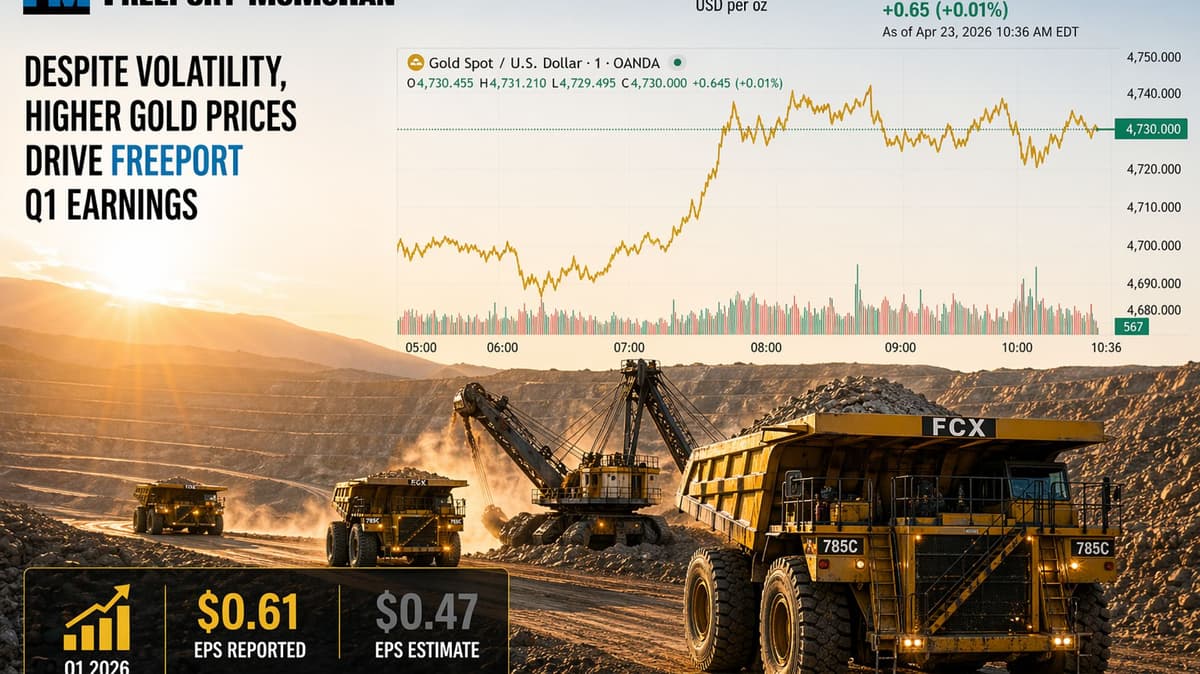
Freeport (NYSE: FCX), a major copper and gold producer, reported net income attributable to common stock of $881 million, or $0.61 per share, in the first quarter of 2026. Adjusted net income attributable to common stock came in at $830 million, or $0.57 per share. That beat consensus analyst estimates of $0.47 per share.
Revenue rose to $6.23 billion, up from $5.73 billion a year earlier. Operating cash flow increased to $1.5 billion.
How Did Higher Gold Prices Boost Freeport's Q1 Earnings?
Higher gold prices were a major driver of Freeport’s earnings growth in the first quarter of 2026. The company said its average realized gold price climbed to $4,889 per ounce, sharply above $3,072 per ounce a year earlier.
That jump in the gold price helped cushion the impact of lower production. It also underlined how sensitive miner earnings can be to bullion prices, especially during periods of strong safe-haven demand and volatile XAUUSD trading.
For Indian investors, this matters because strong realized prices at major global producers can signal ongoing tightness in the international gold market. If global bullion prices stay elevated while the Indian rupee weakens against the U.S. dollar, domestic gold rates in INR can remain firm even when international prices fluctuate.
What Happened to Gold Prices During the Quarter?
Gold prices were highly volatile in the first quarter of 2026. According to the company’s report, gold rose to a record high of $5,600 per ounce in January, then dropped quickly to $4,400 per ounce in early February before recovering to $5,400 per ounce in early March.
Despite that volatility, Freeport still realized an average quarterly gold price of $4,889 per ounce. That shows the broader quarter remained highly favorable for gold-linked earnings.
What Were Freeport’s Q1 2026 Earnings and Revenue Figures?
Freeport beat Wall Street earnings expectations in the first quarter of 2026. The company reported stronger profit, revenue, and cash flow even as production declined.
Here are the key numbers from the earnings report:
- Net income attributable to common stock: $881 million
- Earnings per share: $0.61
- Adjusted net income attributable to common stock: $830 million
- Adjusted earnings per share: $0.57
- Consensus EPS estimate: $0.47
- Revenue: $6.23 billion
- Revenue in Q1 2025: $5.73 billion
- Operating cash flow: $1.5 billion
Why Did Freeport’s Gold and Copper Production Fall?
Production fell mainly because of reduced output at the Grasberg mine in Indonesia following an operational disruption. Freeport said first-quarter gold production dropped to 97,000 ounces, down from 287,000 ounces a year earlier.
Copper production also declined. The company produced 662 million pounds of copper in the first quarter of 2026, compared with 868 million pounds in the first quarter of 2025.
What Happened at Grasberg?
Freeport said the production decline reflected reduced output from the Grasberg mine in Indonesia after a mud rush incident in September 2025. Grasberg is one of the world’s most important copper and gold mining complexes, so any disruption there can affect global supply expectations.
The company said it began a phased ramp-up of the Grasberg Block Cave underground mine in March. However, it also said modifications to ore handling systems will delay a full return to capacity.
When Will Grasberg Return to Full Capacity?
Freeport does not expect a full recovery immediately. The company said near-term production from key sections of the mine will operate at roughly 60% capacity until upgrades are completed.
Full capacity is now expected closer to the end of 2027. That timeline matters for the wider gold and copper market because prolonged constraints at a major producing asset can tighten supply and support prices.
For Indian gold investors, any supply-side stress in large global mines can reinforce bullish conditions in bullion, especially when investment demand remains strong.
How Much Gold Did Freeport Sell in Q1 2026?
Freeport sold more gold than it had internally expected in the quarter. Gold sales totaled 121,000 ounces, and the company said this exceeded internal forecasts largely because of the timing of refined gold shipments in Indonesia.
That distinction is important. Production and sales do not always move in lockstep in the same quarter. A miner can report lower production but still post stronger sales if shipment timing improves.
For market watchers, this helps explain why earnings were resilient despite weaker mine output. Realized prices and shipment timing both supported the quarter.
How Did Copper and Molybdenum Prices Support Results?
Copper and molybdenum prices also helped Freeport’s first-quarter performance. The company said copper prices averaged $5.78 per pound, while molybdenum prices averaged $25.21 per pound.
That matters because Freeport is not a pure gold miner. Its diversified portfolio means strength in copper and molybdenum can complement gains from higher gold prices.
In the Indian context, copper prices also matter because they reflect global industrial demand and broader commodity sentiment. When copper and gold both trade at elevated levels, investors often read that as a sign of both growth expectations and safe-haven interest coexisting in the market.
What Did Freeport CEO Kathleen Quirk Say?
Freeport President and Chief Executive Officer Kathleen Quirk said the first-quarter results reflected the company’s diversified asset base and improving financial performance despite Indonesia-related constraints.
She said:
“Our first quarter financial results reflect the strength of our diversified portfolio, with growth in revenues, cash flow, and earnings compared with last year’s first quarter, despite reduced capacity at our Indonesia operations.”
Quirk added:
“Freeport’s global team is focused on restoring operations at Grasberg safely and sustainably, driving new technologies and efficiency programs to increase the profitability of our Americas operations, and pursuing our highly attractive portfolio of organic growth options to generate value for shareholders. Freeport is strongly positioned as “America’s Copper Champion” and as a global leader in copper, with large-scale, geographically diverse operations and a pipeline of near-, medium-, and long-term growth options to support a growing market.”
Her comments show management is leaning on portfolio diversification, operational recovery, and future expansion rather than short-term production strength alone.
What Is Freeport’s Outlook for 2026?
Freeport maintained a positive full-year 2026 outlook despite its operational challenges. The company forecast full-year sales of about 650,000 ounces of gold and 3.1 billion pounds of copper.
It also expects operating cash flow of about $8.7 billion for the year. That forecast assumes average copper prices of $6.00 per pound and average gold prices of $4,500 per ounce.
Why Does the 2026 Guidance Matter for Gold Investors?
The guidance matters because it offers a real-world industry benchmark for how producers are planning around current gold and copper prices. If gold stays near or above Freeport’s assumed $4,500 per ounce, miner margins could remain strong.
For Indian investors, the outlook is useful beyond mining equities. It suggests that major producers still see gold prices staying historically high in 2026, which can support sentiment in physical gold, digital gold, gold ETFs, sovereign gold bonds alternatives, and jewellery demand decisions.
The next key watchpoint is whether Grasberg’s ramp-up proceeds smoothly and whether global gold prices remain above Freeport’s planning assumption of $4,500 per ounce. If both supply remains constrained and bullion stays elevated, the global gold market could remain supportive for Indian buyers and investors despite ongoing volatility.